
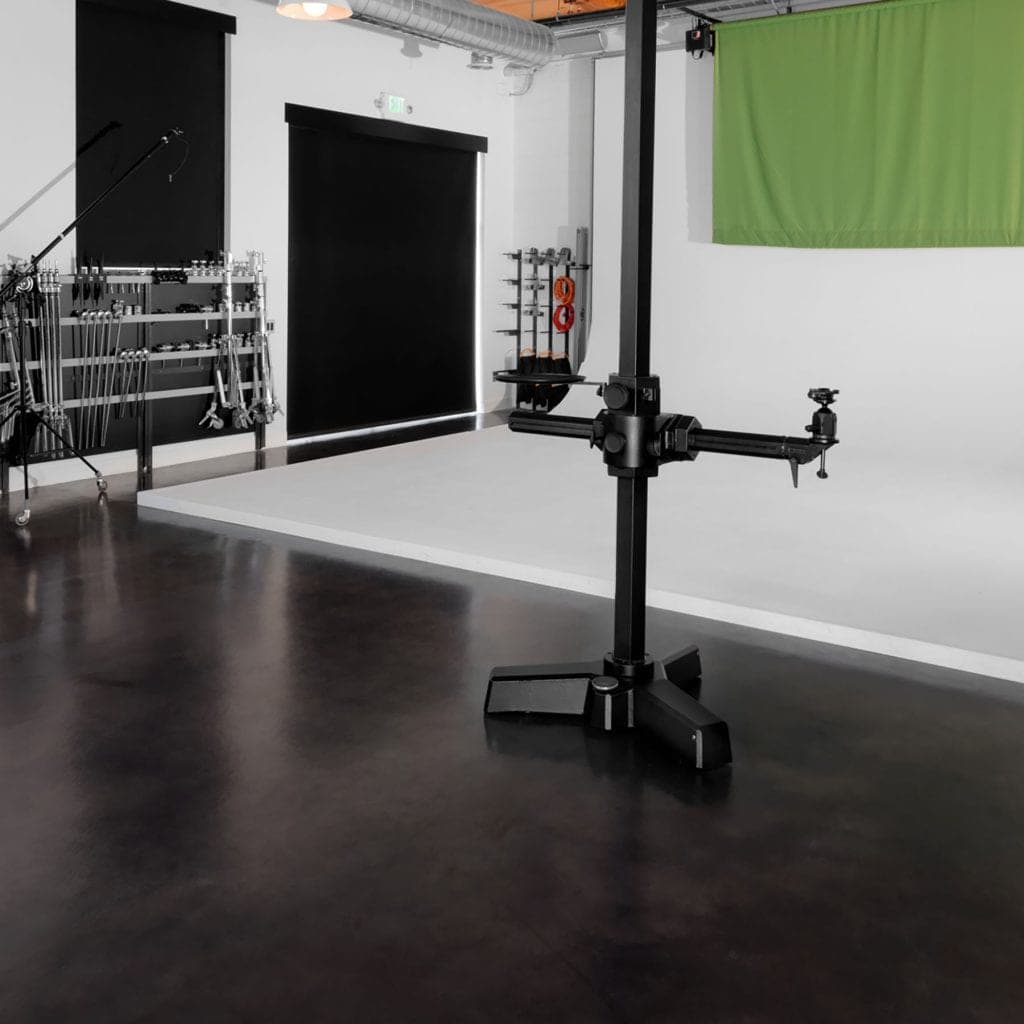
You've seen the look a thousand times without knowing its name: a sneaker, a dancer, a car — sitting in a field of pure white with no floor, no wall, and no horizon to give it away. The subject seems to float in empty space. That illusion has a name, and it has a piece of architecture behind it. It's called a cyclorama, and at photospace it isn't a backdrop you roll out. It's a wall.
A cyc (pronounced "psych") is the single most-requested feature in a commercial studio, and also the most faked. So it's worth understanding what one actually is, why the curve matters, and what separates a real, permanent cyc from a temporary stand-in that photographs almost — but not quite — the same.
What a cyclorama actually is
A cyclorama is a seamless wall that curves smoothly into the floor — and, on a true three-sided cyc, into the side walls as well. There are no hard 90-degree corners where the planes meet. Instead, every junction is a gentle cove, a radius large enough that the camera never sees a defined edge.
That curve is the whole trick. A normal room corner reads as a line in the photo: a dark seam where wall meets floor, the visual cue your eye uses to locate a surface in space. Round that corner off and feather light across it, and the seam disappears. The eye loses its reference, the floor and wall blur into one continuous tone, and the background reads as infinite depth. That's why a cyc is also called an infinity wall or infinity cove.
The photospace cyclorama
- Type
- Permanent, painted hard cyc (not paper or panel)
- Width
- 20 feet
- Depth
- 17 feet
- Height
- 15 feet
- Finish
- Seamless matte white, repainted between campaigns
At 20 feet wide, 17 feet deep, and 15 feet tall, this cyc is large enough to put real distance between your subject and the wall — and that distance is what lets you blow the background to clean white while keeping the subject perfectly exposed. A small cyc forces the subject up against the curve, where spill and shadow are hardest to control. Room to back off is room to work.
How you light a cyc evenly
A cyclorama doesn't make white by itself — paint is just paint, and it photographs as a flat mid-gray under a single light. The infinite-white look is a lighting result, and it comes down to one principle: light the background and the subject as two separate problems.
- Light the wall first. Aim broad sources (strip boxes, large panels, or bounce) at the cove from the sides and top, overlapping their coverage so the falloff is smooth from edge to edge. The goal is an even field with no hot center and no dark corners.
- Meter it up. A clean white background usually sits one to two stops brighter than your subject's key. Less, and white drifts toward gray; much more, and light wraps around your subject and eats the edges. Metering both, separately, is what keeps the line crisp.
- Flag the spill. Because the wall is now brighter than the subject, that extra light wants to creep onto your subject from behind. Flags, floppies, and distance between subject and wall keep it where it belongs.
- Then light the subject. Only once the field is even do you bring in the key and fill. Now the subject is lit on its own terms, sitting in front of a background that simply isn't there.
What it's actually used for
A cyc earns its footprint because so many kinds of work depend on it:
- Product & e-commerce — pure-white isolation in camera, so a catalog of items shares one background with no clipping path or compositing.
- Fashion & look-books — full-length figures with clean negative space the layout team can crop and place type into freely.
- Motion & dance — a performer can move through the frame without a backdrop seam cutting across the shot, and video editors get a clean key surface.
- Automotive & large props — the depth and height swallow a vehicle or a set piece whole, with no corner intruding behind it.
- Headshots & cast — a brand can shoot dozens of people against an identical, repeatable background, hour after hour.
Why a real cyc beats a temporary one
Plenty of rooms claim a cyc and deliver a workaround: a roll of seamless paper taped down the wall and out across the floor, or a curved sheet of quarter-inch plywood propped into a corner. Both photograph passably in a tight crop. Neither holds up when the shot opens up or the day runs long.
Seamless paper wrinkles, scuffs, and dents the moment talent or a cart rolls over it; you're cutting and re-pulling fresh paper through the day, and a wide shot still catches the curl where it leaves the wall. A small plywood cove gives you a curve but not the scale, and its painted seams telegraph in raking light. A permanent, properly built hard cyc has none of those failure points — the cove is structural, the surface takes a beating, and it's repainted between campaigns so every shoot starts on a fresh, unmarked white.
That last detail matters more than it sounds. A cyc that's photographed for years collects scuffs, footprints, and gear marks. Repainting on a campaign cadence means you're never retouching someone else's scuff out of your background — you're shooting on white that's actually white.
When the cyc helps most
Reach for a cyclorama wall when:
- You need a true seamless background and want it solved in camera, not in post.
- The subject is large — a vehicle, furniture, a group, or full-length fashion that a paper roll can't cover.
- There's motion — dance, action, or video where a backdrop seam would cut across the frame.
- Consistency is the deliverable — batches of products or people that all have to share one identical, repeatable background.
- You want creative range from one surface — white today, black or a graduated wash tomorrow, all from the same wall.
If your shoot lives or dies on a clean, infinite background, the wall is the reason to be here. Pair it with the right strobe or continuous lighting to light it the way your shot demands, and the floating-in-space look is in camera before you've touched a single slider.