
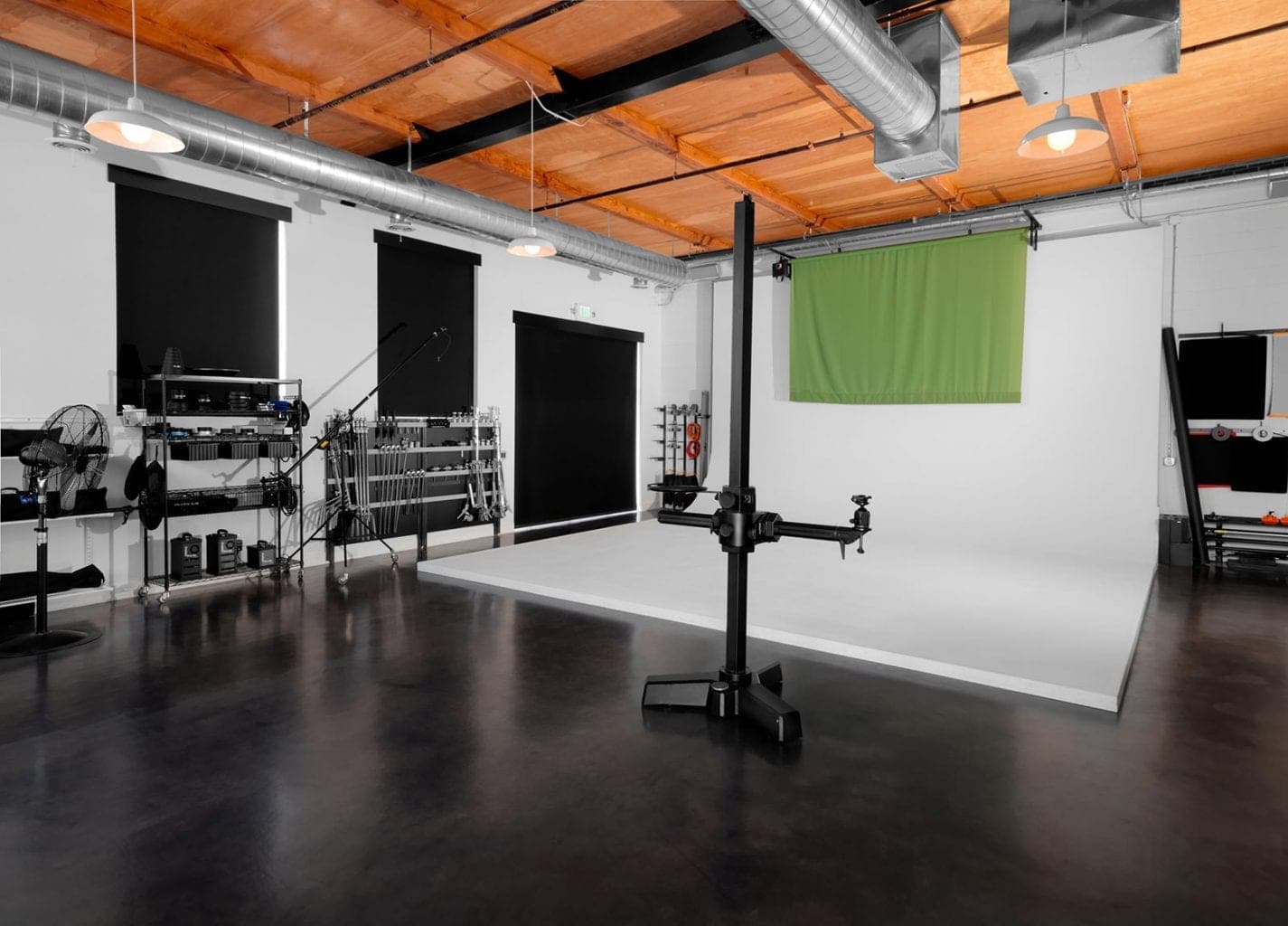
Most studios force a choice you shouldn't have to make. A daylight studio gives you those big, beautiful windows — and no way to turn them off when the sun swings around or a cloud changes your exposure mid-take. A blacked-out studio gives you total strobe control — and a windowless box you've been staring at since 8 a.m. The best rooms refuse the trade-off entirely: full daylight when you want it, total darkness when you don't, and a switch between the two.
At photospace, that switch is real hardware. Giant windows flood the shooting floor with soft daylight, and motorized blackout roller shades drop on command to block 100% of it. You're not choosing daylight or studio at booking time. You're choosing it minute to minute, with a remote.
What controllable daylight actually means
Two pieces of hardware, working as one system:
- Giant windows — a broad, soft, free source of natural light. Daylight off a large window is enormous relative to your subject, which is exactly what makes it flattering: big sources wrap, fill shadows gently, and render skin beautifully with no equipment at all.
- Motorized blackout roller shades — roller-style shades in true blackout fabric that block all of that light when you lower them. They're remote-controlled, so you raise or drop the whole wall of glass in seconds without touching a stand or a clamp.
Why doing both beats doing one
Daylight and strobe each have a job they do better than the other, and a controllable room lets you pick the right one per setup instead of being locked into whatever the building decided.
When daylight wins
Soft window light is free, it's continuous (so what you see is what you get), and it has a natural, lived-in quality that's hard to fake with instruments. For lifestyle, editorial portraits, food, and product work that wants to feel organic rather than lit, a big window is often the best source in the room — and it costs you nothing to use. You can also use it as free fill: leave the shades up to lift your shadows softly, and save your strobe power for the key.
When you kill the light
The moment you need repeatability, you drop the shades. Daylight changes by the minute — a passing cloud shifts your exposure, the sun moves about 15 degrees an hour and walks across your set, and color temperature drifts from cool morning to warm afternoon. None of that is acceptable when frame 300 has to match frame 1. Blacking out gives you a controlled box where the only variables are the ones on your stands:
- Strobe and flash can do their job — freezing motion and overpowering ambient — without daylight leaking in to muddy the result.
- Color is locked to your fixtures, not to whatever the sky is doing, so white balance holds all day.
- Projected and screen-based shots (gobos, video walls, monitor glow) read properly with no daylight washing them out.
- Dark, moody, low-key looks are actually achievable — you can't make true black in a bright room.
A practical way to work the room
Because the switch is instant, you can sequence a shoot around it instead of committing the whole day to one approach:
- Scout the light. Early in the day, raise the shades and see what the daylight is doing. If it's flattering for your first setup, shoot it — free and beautiful.
- Mix when it helps. Use the window as a big soft fill and add a single strobe or LED as your key. You get the warmth of daylight and the control of an instrument in the same frame.
- Black out to lock it. When you hit a setup that has to be consistent — a product run, a look-book, anything batched — drop the shades and go full strobe so nothing drifts.
- Reopen for the next look. Need daylight again for the next setup? Raise the shades and you're back. No tearing down blackout, no re-rigging.
That flexibility pairs naturally with rental light. A continuous LED panel blends seamlessly with window light because both are continuous — you can balance them by eye. And when you black out for control, a strobe or flash kit gives you the punch and motion-freezing daylight can't. The room adapts to whichever you reach for.
When controllable daylight helps most
This matters most when:
- Your shot list mixes moods — some setups want airy daylight, others want controlled, locked strobe, all in one booking.
- You're shooting long — staring at a windowless box for 12 hours is grim; daylight and a view keep talent and crew human.
- Repeatability is non-negotiable for part of the day — you need the option to kill every stray photon and meter from zero.
- You shoot video — continuous daylight is free key or fill, and total blackout lets you control contrast and color for clean grading.
- You want free fill — the window lifts your shadows so you can light with less gear and lower power.
Daylight you can switch off is the rare luxury of having it both ways: the softness and zero cost of natural light, plus the absolute control of a blackout stage, decided per setup instead of per building.