
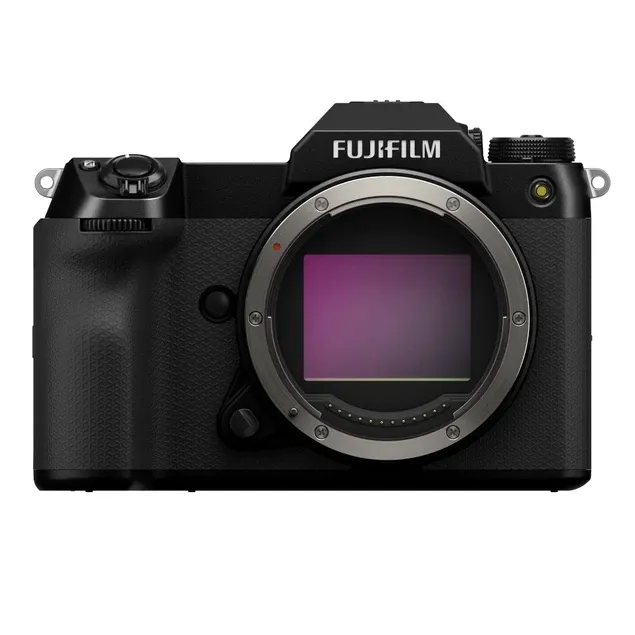
Medium format used to mean a tripod, a tether cable, and a deliberate pace. The Fujifilm GFX 100S quietly broke that rule. It puts a 102-megapixel medium-format sensor in a body that's barely larger than a pro full-frame DSLR, adds in-body stabilization, and shoots like a camera you'd happily carry handheld all day. That combination — medium-format files, full-frame ergonomics — is the whole reason it's on the rental shelf.
It isn't a flagship Phase One and it isn't trying to be. What it is, is the most approachable way to get a bigger sensor and a bigger file onto a job — for a fraction of the cost and none of the ceremony — when full frame is close but not quite enough.
What the GFX 100S is
The GFX 100S is Fujifilm's medium-format mirrorless body on the G mount, built around a 102MP sensor that's meaningfully larger than 35mm full frame. The specs that matter on set:
Fujifilm GFX 100S — key specs
- Sensor
- 102MP medium format CMOS (43.8 × 32.9 mm)
- Mount
- Fujifilm G mount
- Stabilization
- In-body 5-axis, up to ~6.0 stops
- High-res mode
- Pixel Shift Multi-Shot for higher-resolution composites
- Video
- 4K up to 30p · 10-bit (internal 4:2:0, HDMI out 4:2:2)
- ISO range
- 100 – 12,800 (extendable to 50 – 102,400)
- Cards
- Dual SD UHS-II
The sensor area is the point. At 43.8 × 32.9 mm it's larger than full frame, which is where the GFX's tonal smoothness, gentle highlight roll-off, and that slightly three-dimensional rendering come from — even before you spend a single one of its 102 megapixels. If you need to step up again to billboard-scale resolution and leaf-shutter sync, that's a Phase One IQ4 conversation; the GFX sits one rung down, where most medium-format jobs actually live.
Why creators choose it
Resolution and tonality for portraits and product
102 megapixels gives you serious cropping headroom and large-print latitude, but on the GFX the more immediate payoff is tonality. Skin renders smoothly, gradients in product backgrounds stay clean, and there's real detail to retouch into. For beauty, fashion editorial, luxury product, and fine-art work — anywhere the file quality is part of the deliverable — it's a noticeable step up from full frame.
Stabilized and handheld-friendly
In-body stabilization rated to roughly six stops is what makes the GFX 100S feel like a normal camera. You can shoot it handheld in a lifestyle setup, on location, or off the tripod for environmental portraits without giving up the big-sensor look. That freedom is exactly what older medium-format systems couldn't offer, and it's why this body gets booked for shoots a Phase One would never leave the copy stand for.
A pixel-shift mode for the rare extra-detail job
When a subject is static and you want maximum resolution, Pixel Shift Multi-Shot composites several precisely offset exposures into a single higher-resolution file. It's a studio tool — it needs a tripod and a still subject — but for flat reproduction, archival work, or ultra-detailed product, it lets the GFX punch above its native 102MP without renting a larger system.
How it fits a studio workflow
The GFX 100S is happy both ways: tethered to Capture One or Lightroom on a product set for client review, or handheld and untethered for a faster portrait day. Tethered, every 102MP frame lands on the big screen for the art director to approve, and the dual SD slots let you write a backup as you shoot. Pair it with controlled strobe or continuous light and you get the cleanest possible file straight out of camera — our studio tether station is built for exactly this.
The GF lenses are sharp enough to resolve the sensor, and a few zooms cover most of what a studio day needs:
- GF 20–35mm f/4 — wide for sets, interiors, and environmental work where you need context around the subject.
- GF 35–70mm — the do-everything standard zoom; a natural perspective for portraits and general product.
- GF 45–100mm f/4 — short-tele reach for flattering portrait compression and tighter product framing.
Practical setup considerations
Plan storage and post around the file size — 102MP RAWs are large, and a busy session fills SD cards and asks more of your editing machine than full frame does. Note the camera syncs to flash via a focal-plane shutter (the GF leaf-shutter LM lenses are a separate consideration), so confirm your sync speed for the look you want rather than assuming the lens-shutter behavior of a Phase One. And while the body is handheld-capable, the highest-resolution results — and Pixel Shift in particular — still want a solid tripod and careful focus. Lens choice drives the look: reach for the 45–100mm for portrait compression and the 20–35mm when you need the room.
When to rent it instead of buying
Medium format is a part-time need for most shooters, which makes the GFX 100S a strong rental candidate. Rent it when:
- A specific job wants the file — a beauty campaign, a luxury product set, or a fine-art commission — but you don't shoot medium format week to week.
- You want to compare it to a Phase One before deciding which tier of medium format a project actually needs.
- You're a full-frame shooter curious whether the bigger sensor changes your result on a real deliverable.
- The production can bill the rental rather than carry the body on your own shelf.
Our GFX 100S rents as a kit or body-only, with the GF 20–35mm, 35–70mm, and 45–100mm zooms available à la carte from our camera and lens rental. If you're weighing it against a full-frame body or against the Phase One, our medium format vs full frame guide lays out where each one earns its place.