
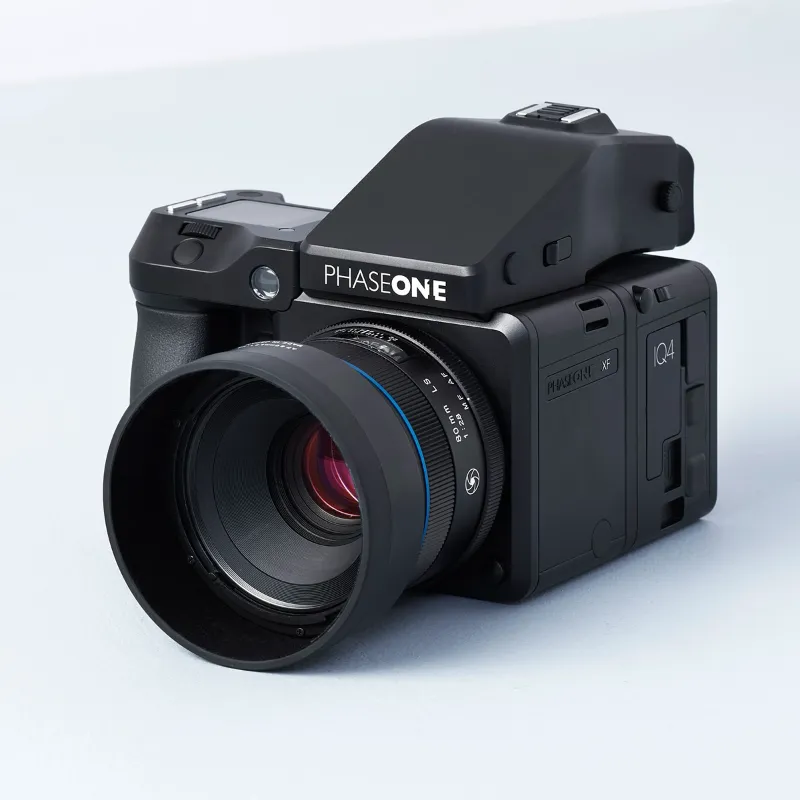
When a studio job is on the calendar, the body question comes up fast: do you rent medium format or full frame? It's easy to assume bigger is always better, but that's the wrong frame. Medium format and full frame solve different problems, and renting the wrong one either leaves resolution on the table or saddles you with files, lens costs, and a slower pace you didn't need. The right answer almost always falls out of one question — what's the deliverable? — not the spec sheet.
This guide compares the two using the bodies on our shelf: on the medium-format side, the Phase One IQ4 150MP and the Fujifilm GFX 100S; on the full-frame side, the Canon EOS R5 and the Nikon Z8. We'll keep it to how they actually differ in a studio, not numbers for their own sake.
What the two formats are
The distinction is sensor size, and everything else follows from it. Full frame is the 35mm-equivalent sensor in bodies like the R5 and Z8 — versatile, fast, and the default for most commercial work. Medium format uses a physically larger sensor, which captures more tonal information and renders with a slightly different, more dimensional character. Our two medium-format bodies sit at different tiers of that world:
The four bodies, by format and role
- Phase One IQ4 150MP
- Top-tier full-frame medium format · tethered, deliberate, billboard-scale
- Fujifilm GFX 100S
- Approachable medium format · handheld-friendly, big files without the ceremony
- Canon EOS R5
- Full-frame hybrid · versatile stills + motion, fast tethered workflow
- Nikon Z8
- Full-frame hybrid · stacked sensor, strong stills and 8K video
Notice there are two answers on each side, and they're not interchangeable. The IQ4 and the GFX are both 'medium format,' but the Phase One is a tethered, copy-stand instrument for the most exacting work, while the GFX shoots much more like a full-frame camera you'd carry handheld. Likewise the R5 and Z8 are both excellent full-frame hybrids with slightly different strengths. Picking a format is step one; picking the body within it is step two.
How to choose: start with the deliverable
Where the file ends up
This is the single most useful question. If the final image lives on the web, in a catalog, on social, or in standard print, full frame is almost always the right call — the R5 and Z8 have more than enough resolution, and the extra data from medium format would be discarded the moment the file is sized down. If the deliverable is genuinely large or unforgiving — a billboard, a flagship-store wall, a gallery print, or fine-art reproduction — that's where medium format, and at the top end the Phase One, earns its rental fee. Match the sensor to the output, and most of the decision makes itself.
How much resolution you actually need
Resolution is really about cropping headroom and print size, not bragging rights. Full frame gives you plenty of room to crop a hero plus tight detail shots from one frame for the vast majority of brand and catalog work. Medium format buys you a further margin — more aggressive crops, larger prints, retouching at extreme magnification — that you only cash in on a small slice of jobs. If you can't name the deliverable that needs it, you probably don't need it.
Tonality and the look
Beyond resolution, the larger sensor renders tonal gradients and out-of-focus areas with a smoothness that some art directors specifically ask for in beauty, luxury, and fine-art work. If the file quality and rendering are part of the brief — not just the pixel count — that's a point in medium format's favor, and the GFX 100S is often the most cost-effective way to get it.
The practical trade-offs
Lens cost and selection
Glass is part of the budget, not a footnote. Full-frame RF and Z lenses are plentiful and span fast primes and zooms, so you can build exactly the look you want for a manageable add-on. Medium-format lenses cost more per lens and there are fewer of them, so plan the focal lengths you genuinely need rather than renting a wall of glass. Factor the lens line into the format decision up front — sometimes the body you want is affordable but the glass to do the job well changes the math.
File handling and post
Bigger sensors mean bigger files, and that ripples through your whole pipeline. Medium-format RAWs — especially from the Phase One — are large, so make sure your cards, card reader, storage, and editing machine can keep up before the shoot day, not after. Full-frame files are still substantial at high resolution but far more forgiving to shoot fast and edit at volume. If the job is high-frame-count or fast-turnaround, that alone can point you to full frame.
Speed and shooting style
Pace matters. Full-frame hybrids are quick — fast autofocus, high burst rates, and the freedom to shoot handheld and untethered when a setup calls for it. The Phase One is the opposite by design: tethered, tripod-bound, and deliberate, which is exactly right for precise product and reproduction but wrong for a fast-moving day. The GFX splits the difference, shooting handheld like a full-frame body while still giving you a larger sensor. Match the camera's tempo to the shoot's tempo.
How it fits a studio workflow
All four bodies tether cleanly into Capture One or Lightroom, so on our studio tether station every frame lands on a big screen for client approval regardless of format. The difference is how you'll work the room. A full-frame hybrid lets you move quickly between setups, shoot handheld for lifestyle and environmental looks, and capture a motion pass from the same body. The Phase One asks you to slow down, lock to a tripod or copy stand, and treat each frame deliberately — which is the whole point on an exacting product or reproduction set. Knowing which way the day needs to go tells you which format to put on the studio booking.
Quick decision guide
If you want a shortcut, this is how the choice usually shakes out:
- Web, social, catalog, or standard print → full frame (R5 or Z8). It's faster, cheaper, and more than enough.
- Stills plus a video pass from one body → full frame; the R5 and Z8 are built for hybrid days.
- Beauty, luxury, or fine-art where tonality is the brief → medium format, often the GFX 100S as the cost-effective entry.
- Billboard-scale product, flagship retail, or museum-grade reproduction → the Phase One IQ4 150MP, tethered on a controlled set.
- Curious before a big commitment → rent the tier you're considering and test it on a real deliverable before you buy.
When to rent it instead of buying
Renting is the natural fit for both formats, for different reasons:
- Medium format is a part-time need — most studios hit a medium-format job only occasionally, and a Phase One in particular costs as much as a car, so renting it for the specific deliverable beats owning it.
- Full-frame bodies depreciate — the body you buy this year is a step behind next year's, so renting the current model and billing it to the production keeps you on the latest tool.
- You can test before committing — rent the GFX or the Phase One on a real job to see whether the larger sensor actually changes your result before spending the money.
- You're matching the tool to the job — rent full frame for the fast week and medium format for the exacting one, instead of forcing one body to do both.
Whichever way the deliverable points, all four bodies — plus the glass to go with them — live in our camera and lens rental inventory, and our team can help you size the right format to the shoot before you book.