
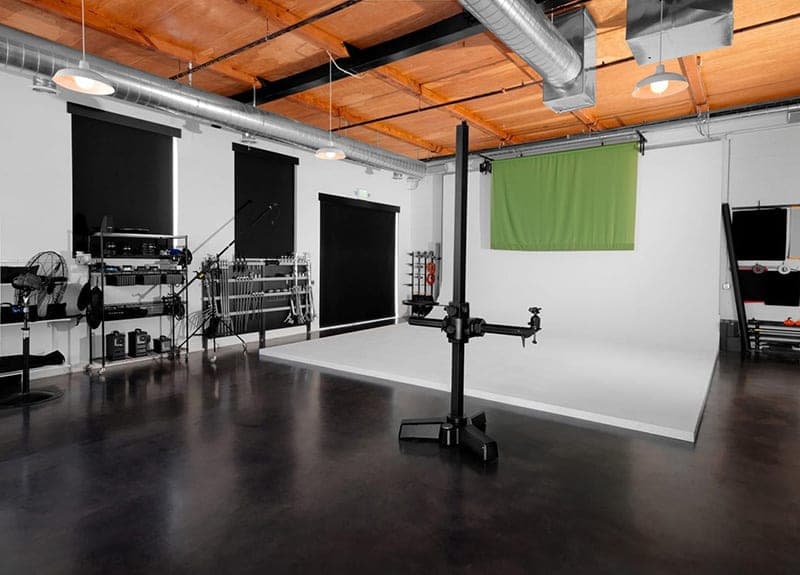
"Should we shoot this in a studio or on location?" is one of the first questions on any production, and the honest answer is: it depends entirely on what the shoot needs. A studio isn't automatically more professional, and a location isn't automatically more interesting. Each is a tool, and picking the wrong one means fighting the environment all day instead of using it. Here's a straight guide to choosing — including the times the answer is location, not the studio.
What a studio is built to give you
A studio's entire value proposition is that you control the variables. Nothing in the room happens unless you make it happen, which is exactly what some shoots require.
- Control of the light. Daylight you can switch off with blackout shades, plus dedicated power to run any lights you want. The light is yours, not the weather's.
- Repeatability. Lock a setup and frame 400 matches frame 1 — essential for product lines, headshot days, and look-books that need one consistent look.
- A clean background. A real cyclorama gives you infinite white (or any color) in camera, no compositing.
- Climate and comfort. A quiet, zoned mini-split holds temperature all day, so a long shoot stays productive instead of punishing.
- Quiet for audio. Sound dampening and silent HVAC make a room where recorded dialogue actually sounds clean.
- Schedule freedom. 24/7 keyless access means you set the call time, not a venue's business hours.
- A review setup. A calibrated tether station so clients approve frames live on a big screen.
Add it up and the studio's pitch is certainty: you can promise a client a specific result on a specific day and actually deliver it, because nothing outside your control can wreck the shot.
What only a location can give you
But certainty isn't everything, and a studio genuinely can't do some things. There are shoots where the location is the point, and trying to fake it indoors costs more time and money than just going there.
- Authenticity. A real restaurant kitchen, a working warehouse, a mountain trailhead — places that read as genuine because they are. Built sets can imply a space, but some stories need the real one.
- Scale and environment. Sweeping landscapes, architecture, wide establishing shots, anything where the surroundings are the subject. No room contains a vista.
- A specific, recognizable place. When the brief calls for that storefront, that skyline, that particular building, the location isn't a choice — it's the requirement.
- Natural context. Lifestyle and documentary work that needs the genuine texture of a real environment, with all its happy imperfections.
- Things that don't move. A property, a vehicle in its setting, an event — sometimes you go to the subject because the subject can't come to you.
When the studio wins
Lean studio when:
- Consistency is the deliverable — batches of products, headshots, or look-book frames that all have to match.
- A clean or seamless background is the goal — solved in camera on the cyc instead of in hours of masking.
- The result is non-negotiable on a fixed date — a client is paying for a specific shot and weather can't be allowed to ruin it.
- Audio is part of it — interviews, podcasts, and dialogue need a quiet, controlled room.
- It's a long day — power, climate, a lounge, and a kitchen turn twelve hours from grueling into workable.
- You need odd hours — overnight builds or a 5 a.m. call that no rented venue would allow.
When location wins
Lean location when:
- The place is the story — a specific, recognizable, or genuinely authentic environment the brief requires.
- Scale is the subject — landscapes, architecture, or wide environmental shots no room can hold.
- The subject can't travel — a building, a property, a vehicle in context, or a live event.
- Authentic texture matters more than control — lifestyle and documentary work that should feel real, not staged.
- You want the unrepeatable — golden-hour light, a real crowd, weather and atmosphere you couldn't build if you tried.
It's often both — and the gear travels
Plenty of productions use each for what it does best: shoot the controlled hero product and the clean-background portraits in the studio, then capture the authentic lifestyle and environmental frames on location. The two aren't rivals — they're complementary halves of one shot list.
And choosing location doesn't mean going without good light. The on-site gear-rental house lets you take professional lighting, camera bodies, lenses, and grip out into the field — so a location shoot gets the same quality of instruments as a studio one, just pointed at the real world. You can even base a hybrid day here: stage and shoot the controlled work indoors, then check out a location package and head out for the rest.
How to decide in one question
When you're stuck, ask: is the environment something I need to control, or something I need to capture? If you need to control it — light, background, climate, schedule, repeatability — that's a studio. If you need to capture it — a real place, real scale, real atmosphere — that's a location. Most briefs answer themselves the moment you frame it that way.