
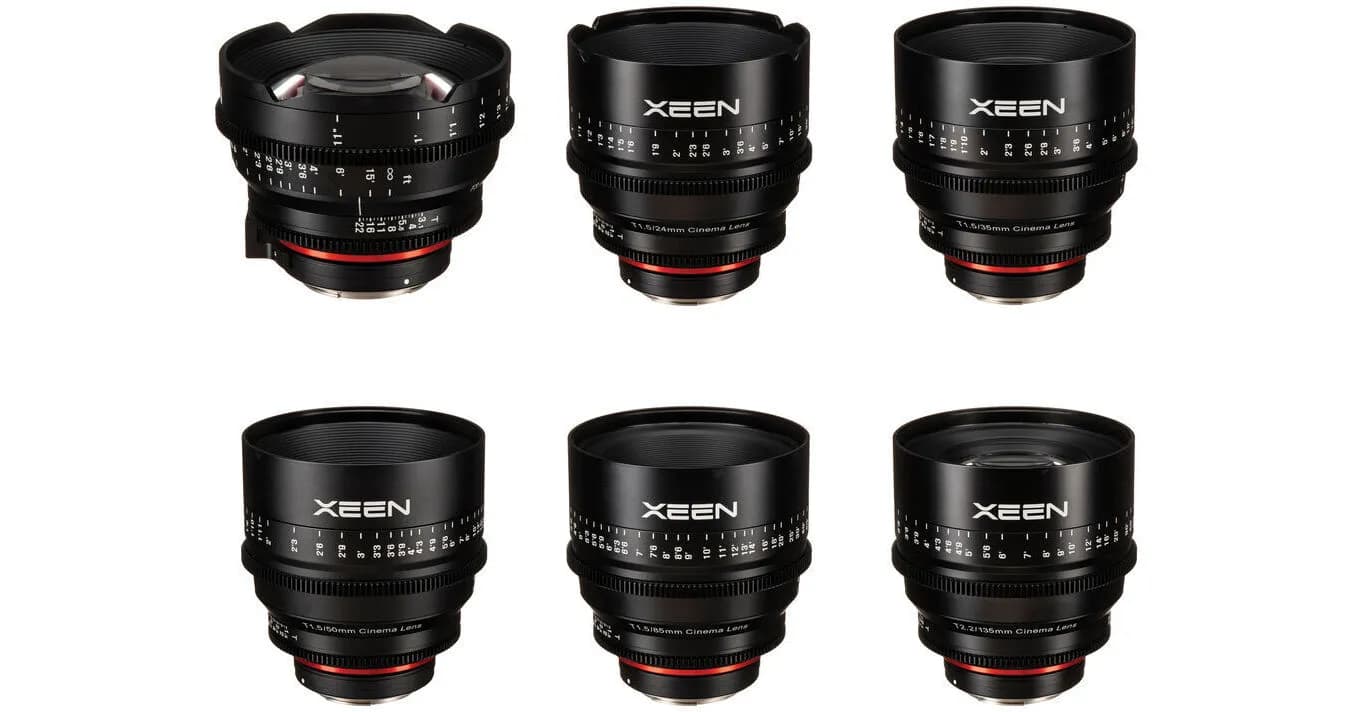
Stills lenses and cine lenses look similar and behave nothing alike on a working set. A photo lens autofocuses, clicks between apertures, breathes when you rack focus, and changes physical size as you zoom — all fine for a single frame, all a problem when a focus puller, a matte box, and a follow-focus motor are involved. Cine lenses are built the other way: manual, geared, smooth, repeatable. The Xeen primes are how a lot of Denver crews get that real cine workflow without paying cinema-glass prices.
What it is
Xeen is the cinema line from Samyang (sold under the Rokinon name in the US) — purpose-built cine primes, not photo lenses with gears bolted on. The whole set is engineered to behave identically so the camera team can swap glass without re-rigging. The features that make it a cine lens:
Xeen cine primes — key features
- Aperture
- Fast T-stops (T1.5 on the 24/35/50/85)
- Iris
- De-clicked, 11-blade circular diaphragm
- Focus throw
- ~200° rotation for precise pulls
- Gearing
- Cine-standard geared focus + iris rings
- Front diameter
- Unified, non-rotating Ø114mm across the set
- Coverage
- Full-frame image circle
- Markings
- Dual-sided focus + T-stop scales
The set we rent is the EF-mount Xeen line — 14mm T3.1, 24mm / 35mm / 50mm / 85mm T1.5, and 135mm T2.2 — available à la carte or as a complete six-lens kit. EF mount means they drop straight onto the Blackmagic URSA we rent and onto most cine bodies via readily available adapters.
Why creators reach for it
A genuine follow-focus workflow
Every Xeen has geared focus and iris rings, and — crucially — those gears sit in the same position on every lens in the set. Swap from the 35mm to the 85mm and your follow-focus motor and matte box don't move; you re-mark and keep rolling. The ~200° focus throw gives a puller room to hit marks precisely (a stills lens crams the same range into a fraction of the rotation), and the non-rotating, unified Ø114mm front means filters and the matte box stay put through a lens change. That's the difference between a set that flows and one that stops to re-rig every setup.
De-clicked iris for exposure on the move
Photo lenses step the aperture in clicks, which is exactly what you don't want on video — every click is a visible, audible jump. The Xeen iris is de-clicked, so it sweeps smoothly. You can ramp exposure mid-take as a subject moves from shade into light, or set the iris precisely between marked stops, with no stepping in the image and no click in the audio. With an 11-blade diaphragm, out-of-focus highlights stay round when you do stop down.
T1.5 speed and a matched look
Cine lenses are rated in T-stops — measured light transmission — not the theoretical f-stops stills lenses advertise, so a T1.5 lens actually delivers T1.5 of light and exposure stays consistent as you change focal length. The fast 24/35/50/85 set at T1.5 buys you low-light latitude and shallow, filmic depth of field, and because Xeen tunes the set for consistent color and rendering, intercut shots from different primes match without a colorist fighting them. They cover a full-frame image circle, so they work on full-frame and Super 35 sensors alike.
How it fits a studio workflow
On a narrative or commercial build in our studio, Xeen primes slot into a standard cine rig the way they're meant to:
- Rig once, swap freely. Set your matte box and follow focus on the unified front and gear positions, then change focal lengths without re-rigging between setups.
- Cover the day with the kit. The 14mm for tight-space wides and establishing shots, the 24–50mm for coverage and dialogue, the 85mm and 135mm for clean close-ups and compression.
- Pull focus, not autofocus. With marks on the dual-sided scales, the camera team owns focus deliberately — the right call for controlled, lit scenes.
- Match a fast zoom when you need one. Add the Sigma 18–35mm T2, a constant-T2 cine zoom, for run-and-gun coverage between prime setups.
Setup considerations
Xeen primes are manual-focus, manual-iris lenses — there's no autofocus and no electronic aperture, by design. That means you'll want the support around them: a follow focus (or a focus motor), ideally a monitor for the operator and a puller, and marks on the lens scales. Budget a little time at the head of the day to build the rig and set your first marks; after that the set is fast because nothing has to change between lenses. They're heavier and longer than the equivalent stills primes — that's the geared, all-metal cine build — so plan your support and balance accordingly, especially on a gimbal. And while a single Xeen is a great way to add one focal length to a shoot, the value of the line is the matched set: identical handling, identical front, consistent look, so the whole kit behaves as one.
When to rent it instead of buying
Cine glass is a tool you reach for per-project, and a full six-lens prime set is a real investment that sits idle between shoots. Renting is how most crews put a proper cine kit on a job:
- The production pays for the glass — bill the kit to a spot or a short and return it when you wrap.
- You need the full set for one shoot — grab all six primes for a narrative day without owning a cine kit year-round.
- You're moving up from stills lenses — try a real geared, de-clicked workflow before committing to buying cine glass.
- You're already booking the room — add the Xeen kit to a studio booking and walk in ready to rig.
We rent the Xeen primes individually or as the complete six-lens EF kit, so you can take a single focal length or the whole set, and pair it with the Blackmagic URSA and a fast Sigma zoom for a full video build from one place.