
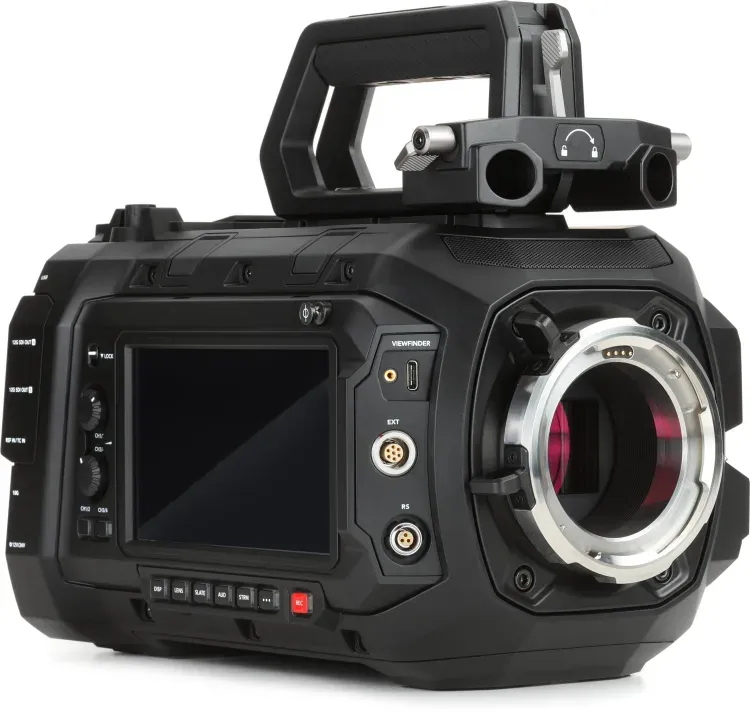
A hybrid mirrorless body will shoot you a beautiful clip, but there's a point in a video job where you want a camera that was built to be a camera — physical buttons for every setting, built-in NDs, a real recording pipeline, and a body that balances on a shoulder rig instead of disappearing into one. That's the lane the Blackmagic URSA Mini Pro 4.6K G2 lives in: a dedicated Super 35 cinema camera at a price that makes renting it for a single shoot an easy call.
It's the body we hand to directors and DPs who want cinema-grade image control — RAW capture, deep grading latitude, and the broadcast-style ergonomics of a purpose-built camera — without stepping up to a full rental-house cinema package.
What the URSA Mini Pro 4.6K G2 is
It's a Super 35 digital film camera with an interchangeable EF mount and a full set of external controls. The specs that define how it shoots:
Blackmagic URSA Mini Pro 4.6K G2 — key specs
- Sensor
- Super 35, 4.6K HDR (4608 × 2592)
- Dynamic range
- 15 stops
- Frame rate
- Up to 120 fps at 4.6K; up to 300 fps windowed HD
- Mount
- EF (interchangeable; optional PL, B4, F)
- Built-in ND
- Clear, 2-stop, 4-stop, 6-stop filter wheel
- Recording
- Blackmagic RAW + Apple ProRes to dual CFast 2.0 / dual SD UHS-II
- External media
- USB-C expansion port for recording to disk
The two specs that change how you work are the 15 stops of dynamic range and Blackmagic RAW. Together they give you enormous latitude to grade — recover highlights, lift shadows, and dial in a look in DaVinci Resolve — from a file that stays efficient to store and edit. The built-in ND wheel matters more than it sounds: you change your effective exposure for shallow depth of field in daylight with a flick instead of swapping filters, which keeps a shoot moving.
Why directors and DPs choose it
Grading latitude from RAW and 15 stops
Highlight and shadow detail is where consumer video falls apart and cinema cameras pull ahead. With 15 stops captured to Blackmagic RAW, you can expose for the scene and make the creative decisions in the grade — protecting a bright window, holding detail in a dark wardrobe, matching shots across a sequence. For commercial spots and branded films where the color treatment is part of the brief, that latitude is the reason to shoot this body over a hybrid.
Controls and ergonomics built for a crew
The G2 carries a full set of broadcast-style external controls, a backlit status display, and a foldout touchscreen — so a focus puller, a DP, and an operator can each work without diving into menus. It builds onto a shoulder or studio rig naturally, takes a proper EVF, and behaves like the dedicated tool it is on a set with more than one person touching the camera.
High frame rates for motion and beauty passes
Up to 120 fps at 4.6K (and far higher windowed) gives you genuine slow motion for product beauty shots, fabric and liquid motion, and dramatic reveals. Recording RAW or ProRes to dual CFast or SD cards — or out to an external disk over USB-C — means you can shoot those high-bitrate clips without worrying about where the next take goes.
How it fits a studio workflow
A controlled room is where this camera shines. On the cyc wall or a product set you can light precisely, use the built-in NDs to open up your aperture under bright continuous light, and monitor a clean Super 35 image while a director watches the same feed. The RAW pipeline pairs naturally with a grade-forward post workflow, and because it's a dedicated cinema body you can leave it built up on a rig for the day rather than reconfiguring between setups. Book it alongside the room from our studio booking and walk in ready to roll.
Glass makes the cinema look, and the EF mount opens up a clean set of cine options on our shelf:
- Xeen cine primes (14, 24, 35, 50, 85, 135mm) — a matched T-stop prime set with geared focus and iris for consistent rendering across the build; available as singles or a six-lens kit.
- Sigma 18–35mm T2 — a fast, sharp cine-housed zoom that covers most run-and-gun coverage without a lens change.
- BMPCC EVF and NP-F570 batteries — a proper eye-level finder and power to keep the body running through the day.
Practical setup considerations
Plan media and power before the shoot day. Blackmagic RAW is efficient, but 4.6K and high-frame-rate clips still move data fast, so bring fast CFast 2.0 or SD UHS-II cards (or an external USB-C disk) and confirm your offload and backup plan. Budget time to build the camera — a cinema body is meant to be rigged with an EVF, follow focus, and support, not shot bare — and choose your lenses to the job, leaning on the Xeen primes when matched rendering matters and the Sigma zoom when speed does. Confirm exact recording formats and frame-rate combinations on the camera for the codec you intend to deliver, and set your ND with the built-in wheel to hold the aperture your look calls for.
When to rent it instead of buying
A cinema camera and a set of cine primes is a serious purchase that most shooters only need intermittently — which makes it close to an ideal rental. Rent it when:
- The project pays for the package — bill the body and glass to the production and hand it back at wrap.
- You need a real cinema look for a spot or branded film beyond what your hybrid body delivers.
- You want a matched prime set for a job without owning a full cine kit.
- You shoot video occasionally — a few productions a year doesn't justify owning the system.
Our URSA Mini Pro 4.6K G2 rents with the EF mount, and the Xeen primes, the Sigma 18–35mm T2, an EVF, and batteries are all available à la carte from our camera and lens rental — so you can build the exact package the shoot needs and shoot it in a room built for it.