
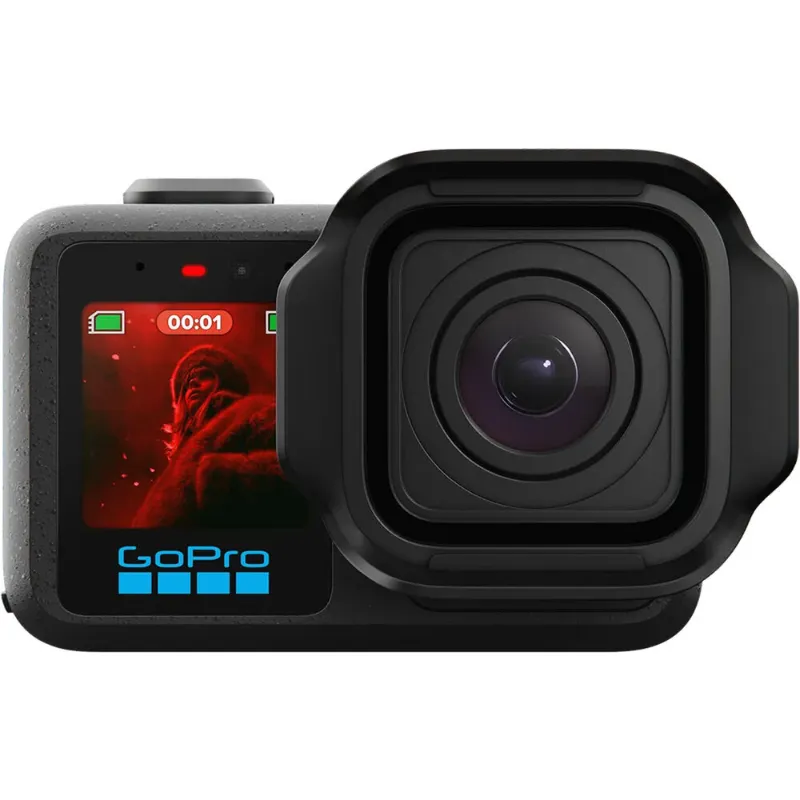
Every shoot generates a second set of content nobody planned for: the behind-the-scenes reel, the time-lapse of the build, the close-in POV shot the main camera physically can't reach. A cinema body or a mirrorless hybrid is the wrong tool for all of it — too big, too precious, too slow to reposition. A GoPro is the right one. The HERO11 Black is small enough to clamp anywhere, tough enough to not baby, and good enough now that its footage cuts cleanly into the same edit as your A-camera.
It's the camera you put where you'd never put a real lens — inside the product rig, on the talent, low to the floor, out in the weather — and it earns its place on the shelf precisely because it goes where nothing else will.
What the HERO11 Black is
It's GoPro's flagship action camera, built around a larger, taller sensor than past models. The specs that matter for production use:
GoPro HERO11 Black — key specs
- Sensor
- 1/1.9" CMOS, ~27MP — taller 8:7 aspect
- Max video
- 5.3K up to 60 fps · 4K up to 120 fps · 2.7K up to 240 fps
- Color
- 10-bit (HEVC) on supported modes
- Stabilization
- HyperSmooth 5.0 with built-in Horizon Lock
- Aspect ratios
- 8:7, 4:3, 16:9 (frame multiple deliverables from one capture)
- Waterproof
- 10 m (33 ft) out of the box
- Power
- Removable Enduro battery for better cold-weather runtime
The quietly important spec is the 8:7 sensor. Because it captures a nearly square frame, you can shoot once and crop a wide 16:9 cut, a vertical 9:16 for social, and a square 1:1 all from the same file. For content-first brand work, that single capture feeding every aspect ratio is a genuine production shortcut — and 5.3K resolution gives you the headroom to reframe and stabilize without the image falling apart.
Why creators reach for it
It goes where the big camera can't
The whole value proposition is access. Mount it inside a product setup, on a moving subject, low to the ground, or out in rain and dust, and you get a usable shot from an angle the main camera could never hold. On a commercial set it's the BTS rig running in the corner all day; on a product shoot it's the tiny camera that lives inside the action for the motion clip.
Stabilization that makes handheld look intentional
HyperSmooth 5.0 with Horizon Lock turns shaky, run-and-gun movement into footage that reads as a deliberate moving shot. You can walk the camera through a space, hand it to talent, or rig it to a moving subject and trust that the result will be smooth and level — no gimbal required for the kind of energetic, immediate motion that BTS and social content want.
One capture, every aspect ratio
The 8:7 sensor plus 5.3K resolution means you're not choosing a format at capture time. Shoot the moment once, then deliver a horizontal hero cut, a vertical for Reels and TikTok, and a square for the feed — all reframed in the edit from a single clip. For social-first campaigns that need every aspect ratio anyway, that's real time saved.
How it fits a studio workflow
On a studio shoot the HERO11 is the supporting player that makes the deliverables list longer for almost no extra effort. Clamp one to a stand or a piece of grip to roll a time-lapse of the set build, mount one inside or beside a product rig for the in-action motion clip, and let the talent hold one for a POV beat — all while the main camera handles the hero frames. The 10-bit footage grades reasonably alongside your A-camera, so the cutaways and BTS sit in the same timeline instead of looking like a different shoot. Book it alongside the room from our studio booking and capture the whole day, not just the hero shot.
Accessories turn the bare camera into a small production kit, and they're where the kits differ:
- Media Mod — adds a directional mic input and ports so on-camera audio is usable, not an afterthought.
- Display Mod and Light Mod — a front-facing screen for framing yourself and a small built-in light for close work.
- Volta battery grip — extends runtime well past a single battery and doubles as a grip, remote, and tripod for long captures.
- GoPro Max (360) — a separate 360 camera on the shelf for reframable, shoot-everything coverage when you want it.
Practical setup considerations
A few things keep a GoPro day smooth. High-resolution, high-frame-rate modes drain batteries and fill cards quickly, so rent spares or the Volta grip and bring a fast, high-capacity microSD card rated for the bitrate. The camera can warm up during long 5.3K records — give it airflow on extended takes. Choose your mode for the deliverable: the 8:7 high-resolution mode when you'll reframe to multiple aspect ratios, a flatter color profile when you intend to grade it next to your main camera, and high frame rates only where you actually want slow motion. And mount it thoughtfully — the access angle is the entire reason it's there, so spend a minute getting the clamp or rig right.
When to rent it instead of buying
A GoPro is inexpensive enough to own, but renting still makes sense more often than you'd think. Rent it when:
- You need several at once — multiple angles, a multi-cam POV moment, or a camera you're willing to put somewhere risky.
- You want the current model rather than the older one in your drawer, with its better sensor and stabilization.
- The shoot needs the accessories — the Media Mod, Volta grip, or a 360 Max — without buying a pile of add-ons you'll use once.
- The production can bill it alongside the rest of the gear order.
Our HERO11 rents as a Standard or PLUS kit, or body-only, with the Media, Display, and Light Mods, the Volta battery grip, and the 360 Max all available from our camera and lens rental. Add one (or a few) to the gear order and capture every angle of the day.