
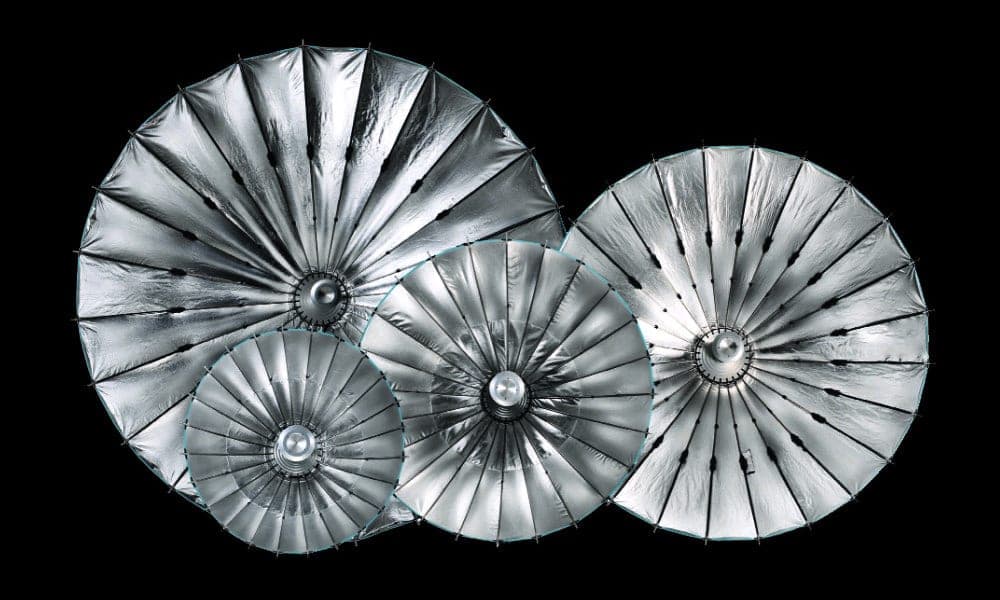
Most modifiers do one thing. A softbox is soft. A grid reflector is hard. A parabolic is the rare tool that does the whole range — and the Broncolor Para 177 is the one a lot of high-end shooters consider the gold standard. It's a deep, silver, umbrella-like dish roughly six feet across, built from 24 reflective segments, that mounts your flash head on a sliding rod inside it. Slide the head in and out and the character of the light changes completely. That single adjustment — focusing — is what makes the Para special, and it's why one rental can replace a whole case of modifiers for a day.
What it is and what it does to light
A parabolic reflector concentrates light according to where the source sits along its axis. Broncolor confirms the mechanism plainly: the light is reflected in the 24 segments of the Para and focused depending on the position of the focusing tube that carries the lamp. Move the lamp toward the focal point and the segments collimate the beam into a tight, punchy, near-spot quality with crisp shadow edges and a brilliant specular highlight. Pull the lamp back out of focus and the segments scatter the light into a large, soft, wrapping source — Broncolor's own description spans 'from soft to spot-like,' from a 'powerful spot' to a 'soft light cloud.'
The defocused look is the one people chase. Because the whole ~170 cm (about six-foot) silver surface becomes the emitter, you get an enormous apparent light source that still has direction and a distinct, almost three-dimensional falloff: as Broncolor describes it, the strongest luminosity sits at the center of your subject and decreases evenly outward, so the light seems to model the form rather than just flood it. It reads as soft and contrasty at the same time — a combination that's very hard to fake with anything else.
Broncolor Para 177 — confirmed facts
- Type
- Focusable parabolic reflector (24 segments)
- Open size
- ≈ Ø 170 × 95 cm (77 × 37") — roughly 6 ft across
- Surface
- High-gloss silver textile reflector
- Focusing
- Crank-handle setup; lamp slides on a focusing tube
- Range
- Punchy spot ↔ soft 'light cloud,' plus optional diffusers
- Heads
- Mounts our Profoto heads via the Para adapter
We run the Para on our Profoto strobe heads through a Para adapter — Broncolor makes adapters for Profoto and several other systems, so you can drive this Swiss modifier with the Profoto packs and monolights already on the shelf. Three optional diffusion levels are available on the Para system if you want to push the soft end even further.
The look it creates
Defocused, the Para gives that signature high-end fashion and portrait light: soft, glowing skin with real depth, a gentle wrap that doesn't go flat, and a long, even falloff that sculpts cheekbones and shoulders without harsh shadow lines. Focused, it snaps into a dramatic, directional key with a hard specular edge — great for graphic editorial, watch and jewelry product work, or a moody single-light beauty frame. The fact that you can travel between those extremes by turning a crank, without changing modifiers or remetering from scratch, is the entire pitch.
Best subjects and use cases
- High-end fashion and portrait — the defocused 'big soft with depth' look that defines a lot of editorial and campaign work.
- Beauty — a single Para can be the whole key, with the focus dialed to taste.
- Premium product and still life — focused, it becomes a controllable directional source for watches, bottles, and cosmetics.
- Full-length and group — its size gives even, head-to-toe coverage that small modifiers can't.
In the studio and on the cyc
A six-foot parabolic needs room, height, and a clean floor — exactly what the studio is for. There's enough ceiling to fly it high and enough space to back your subject off the cyc wall so the Para's falloff reads on the background as a gradient rather than a hot spot. Because the room is controlled, you can commit to a single dramatic key from the Para and shape the rest of the frame with negative fill, instead of fighting ambient light. It's a modifier that rewards a real stage.
Setup and control
The Para 177 sets up by crank handle and collapses for transport, but it is a large, premium piece — give it a sturdy stand and a moment to rig. A few working notes:
- Focus is your main creative dial — sweep the lamp through its travel and watch the shadow edges go from soft to crisp; park it where the skin looks right.
- Distance still matters — like any source, closer is softer and falls off faster; the Para is big enough to stay soft even from a fair distance.
- Feather it — aim the hot center past your subject and light them with the edge of the beam for the smoothest, most flattering gradient.
- Add diffusion only if needed — the optional diffusers push it softer still, at the cost of some of that signature directionality.
When to rent it
The Para is a serious investment to own and a specialist look to master — which makes it close to the ideal rental:
- You want the parabolic look for a specific campaign, editorial, or hero shot without a four-figure purchase.
- You need one modifier that covers the range — soft to spot — on a day with varied setups.
- You're shooting in a room with the height and space to fly it properly.
- You're already renting the studio and a Profoto head — add the Para and the adapter and shoot it on the cyc.
We rent the Bron Para 177 by the day and run it on our Profoto heads via the Para adapter. If you want the parabolic-adjacent look at a smaller scale, the Elinchrom Deep Octa 39" and the Indirect Octa 75" on the modifier wall give a deep, wrapping quality without the full focusing system.