
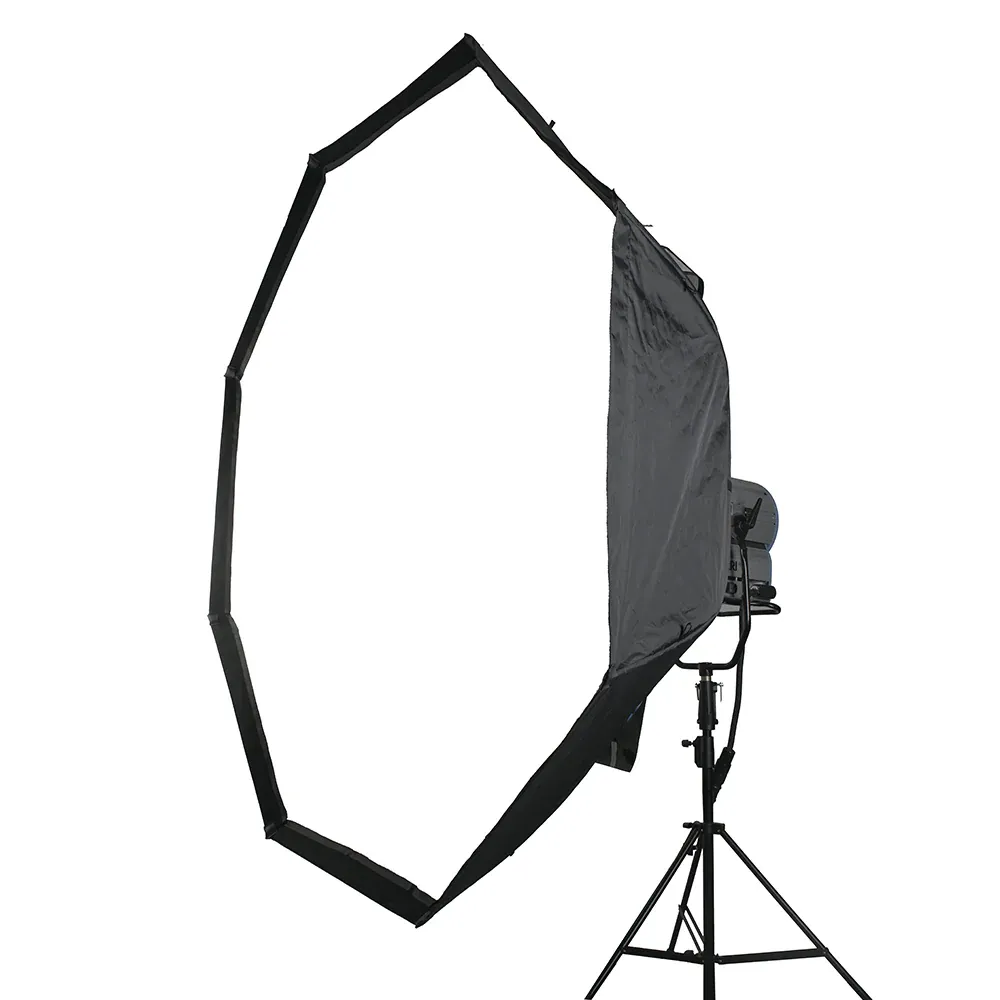
Three modifiers do most of the soft-light work on any shoot: the softbox, the octa, and the umbrella. They share one job — taking a small, hard flash tube and turning it into a big, gentle source — but they each go about it differently, and those differences show up in your pictures. The size and shape of the source set how soft the shadows are and how the catchlight looks; how the light leaves the modifier sets how much spills onto your set. Get the match right and the light does what you imagined. Here's how the three compare, using the modifiers on our wall.
What makes light soft in the first place
One principle drives all three: the larger the source relative to the subject, the softer the light. A bare flash is a tiny point, so it casts hard, sharp-edged shadows. Stretch that light across a three-foot panel of diffusion and the shadow edges go soft and gradual, because light now reaches the shadow line from many angles. Bring any modifier closer and it gets bigger relative to your subject — and softer. Push it back and it gets smaller and harder. So 'which modifier' is really two questions: how big is the surface, and how controlled is the light that comes off it.
The softbox: soft light you can aim
A softbox is a rigid, enclosed box — opaque on the sides, diffusion on the front — so light only leaves through the front panel. That enclosure is the whole point: it gives you directional soft light with relatively little spill, which means you can put light where you want it and keep it off the background, the cyc, or the next setup. Our Chimera SuperProPlus boxes are the workhorses here, and they come in rectangular sizes plus long, narrow strip boxes.
- Quality — soft, even, slightly more contained than an octa of the same size; the rectangular shape leaves a rectangular catchlight.
- Control — the best of the three; the rigid walls and optional grids let you feather and flag the light precisely.
- Strip boxes — tall and thin, ideal for edge and rim light on a body, gradients on a background, or lighting bottles and full-length figures.
- Add a grid — a fabric grid over the front narrows the spread for dramatic, controlled portraits and clean product light.
Choose a softbox when control matters: product and still life, tight studio builds with multiple lights, anything where you can't have soft light splashing onto the cyc.
The octa: the most natural soft key
An octabox is an eight-sided softbox — close to round. That round shape is why it's the default for portraits and beauty: it throws a smooth, natural, near-circular wrap and leaves a round catchlight in the eyes that reads like daylight, not like a window. Our Octa 3' and 5' cover the range from a punchier single-person key to a big, soft, wrapping source.
- Quality — soft and enveloping, with a gentle gradient that flatters skin; the larger 5' wraps generously for half- and full-length.
- Catchlight — round, the shape most people read as flattering and natural.
- Control — slightly less contained than a softbox of equal size, but still directional and grid-able.
- Use it as your one-light key — an octa plus a reflector is a complete, elegant portrait setup.
Choose an octa when the face is the subject: portraits, beauty, headshots, fashion. If you want that wrap even deeper, a parabolic like the Broncolor Para takes the idea further still.
The umbrella: big, fast, and forgiving
Umbrellas are the quickest soft light you can rig — pop one open, slide it into the bracket, and you're shooting. They come in two flavors, and the difference is where the light goes. A shoot-through umbrella fires the flash through a white diffusion panel toward the subject: very soft, but it spills light everywhere. A reflective umbrella (white or silver interior) bounces the flash back off the inside: a bit more contained and, with silver, punchier. Our Westcott 7' parabolic umbrella is an enormous, ultra-soft source for full-length and groups; the Westcott 45" is a fast, all-purpose soft light; and the Profoto Deep umbrellas are a more controlled, focusable take that behaves more like a parabolic than a flat brolly.
- Quality — soft and a little less even than a box, with a rounder, often less-defined catchlight (shoot-through can look very natural).
- Spread — the widest of the three; shoot-through especially fills a whole room, which is a feature for big groups and a liability in tight builds.
- Control — the least of the three; you trade precision for size, speed, and value. The deeper umbrellas (Westcott 7', Profoto Deep) tighten this up considerably.
- Value — the most coverage per dollar, and the fastest to deploy.
Choose an umbrella when you need a lot of soft light, fast — full-length fashion, large groups, event-style headshots — or when a deep parabolic umbrella gets you a parabolic-ish wrap without the cost.
Quick comparison
How they stack up
- Softbox
- Most control + least spill · rectangular catchlight · product, tight builds
- Strip box
- Tall + narrow · edge/
rim, gradients, bottles, full-length - Octa
- Most natural wrap · round catchlight · portraits + beauty
- Umbrella
- Biggest, fastest, widest spread · best value · groups, full-length
- Deep umbrella
- Umbrella speed, more parabolic-like control + punch
On the cyc and in the studio
In the studio, the choice often comes down to spill. On a white cyc, a contained softbox lets you light the subject and control the background separately; a giant shoot-through umbrella will wash the whole cyc with light, which is sometimes exactly what you want for a clean high-key look and sometimes the thing wrecking your gradient. Match the modifier to the build, and you spend less time flagging light you didn't mean to spill.
When to rent them
Modifiers are cheap to rent and bulky to own, so it's easy to bring exactly the shapes a shoot needs:
- Match the modifier to the job — rent an octa for a portrait day, strips for product, a big umbrella for a group, instead of forcing one box to do everything.
- Try shapes side by side — compare a softbox and an octa on the same face before you commit to buying.
- Go big without storing big — a 7' umbrella or a 5' octa is a hassle to own and easy to rent.
- You're already booking the room — add the modifiers to the studio reservation and walk in ready.
We rent Chimera SuperProPlus softboxes and strips, Octa 3' and 5', the Westcott 7' parabolic and 45" umbrellas, and Profoto Deep umbrellas — all mounting on the Profoto heads from the strobe wall.