
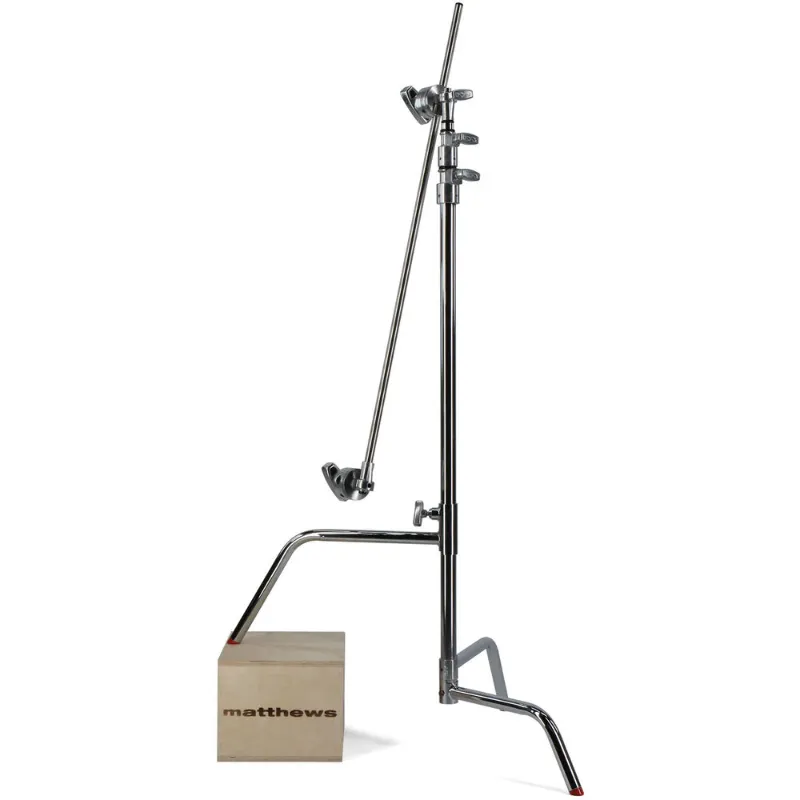
Walk onto any professional set and you'll see them everywhere: chrome stands with three splayed legs and a long arm reaching out over the action, each one holding a flag, a light, or a reflector exactly where it needs to be. The C-stand — short for 'century stand' — is the single most useful piece of grip gear ever made. It's also the one beginners set up wrong most often, and a badly rigged C-stand is how lights hit the floor and flags hit people. The good news: doing it right is a handful of simple rules you can learn in five minutes and trust for the rest of your career.
What a C-stand is and how it works
A C-stand is a heavy-duty support stand built to hold things out in space, not just straight up. It has three parts worth knowing by name:
- The base and legs — three legs of different heights, nested so the tallest leg is set lowest and the others stack above it. This stepped design is the secret to its stability: the legs fold flat for transport but spread wide and at staggered heights when deployed.
- The riser column — the vertical chrome tube that telescopes up, raising your rigging point. A 40-inch C-stand gives more height and reach than a 20-inch; both fold compact.
- The grip head and arm — a 2½" grip head (also called a gobo head) clamps to the top of the riser, and an extension arm slides through it so you can position a load away from the base, out over your subject or set.
That arm is the whole point. A normal light stand can only hold weight directly over its own base. A C-stand, with its arm and head, lets you hang a flag or a light off to the side — over a table, in front of a window, just above an actor's eyeline — where no stand leg could ever reach. That reach is also exactly what makes it tip over if you rig it backwards, so the technique below is non-negotiable.
Why it matters on set
In a controlled studio you're building light deliberately: a flag here to kill spill off the lens, a net there to knock a hot edge down a stop, a small light boomed in from above. Almost all of that hangs off C-stands. They're the connective tissue between your lighting plan and the actual photons hitting the sensor. Get comfortable with C-stands and you can shape light precisely and repeatably; fumble them and every setup is slow, shaky, and one bump away from a broken modifier.
Setting one correctly (and safely)
Put the tallest leg under the load
This is the rule that prevents most C-stand accidents. When you extend the arm out to one side, all the weight on the end of that arm wants to pull the stand over in that direction. So you orient the base with the tallest (lowest) leg pointing the same way the arm and load are pointing. The long leg becomes the foot the load leans into, and the stand stays planted. Rig it the other way — load over a short leg, long leg behind you — and you've built a lever designed to fall toward your set. Memorize it: the high leg goes under the load.
Mount the grip head so gravity tightens it
Every grip head has a knuckle you tighten by turning the knob. Here's the trick nobody tells you on day one: rig the head so that if the load slips, it slips in the direction that tightens the knuckle, not loosens it. The standard convention is to approach the head from the right — picture the knob on the right side and the load hanging so its weight rotates the joint toward 'tight.' Set up this way, a heavy modifier actually helps clamp itself in place. Set up backwards and the same weight slowly unwinds your grip until it droops or drops. The same logic applies to the arm passing through the head: orient it so the load can't unscrew the joint.
Always sandbag — every time, no exceptions
A sandbag is a soft, saddle-shaped weight you hang over the tallest leg of the stand, right where it meets the base. It does two jobs: it lowers the stand's center of gravity and it adds real mass over the leg that's resisting the tip. The heavier and more extended your load, the more sand you need — a small flag might be fine with a 15 lb bag, while a boomed light reaching out over your subject wants a 25 or 35 lb bag (or two). Drape the bag so it straddles the leg like a saddle; don't just set it on the floor next to the stand, where it does nothing. If a C-stand has an arm extended, it gets a bag. Always.
Brace it the rocky-mountain way
When you have to rig a stand on a slope or build it tall and heavy, plant your own foot on the lowest leg as you raise and load it — the 'rocky mountain leg' stance. Your body weight steadies the base while your hands are busy, and you feel the stand's balance before you let go. It's a habit that keeps a stand from walking on you the instant a modifier catches a draft. Combine it with a bag and you've got belt and suspenders.
C-stands in the studio workflow
On a typical build you'll burn through more C-stands than you'd guess — a couple holding the key's flags and nets, one booming a hair light in from behind, another flying a bounce card to open up shadows, one more pinning a backdrop or holding a practical. In a controlled studio, where you're metering light and locking it down for a long day of consistent frames, that little forest of stands is what makes your lighting reproducible: nothing moves until you move it. Reach for a 20-inch stand for low, tight work near a tabletop and a 40-inch when you need height and a longer arm to clear the set. Add gobo and double grip heads when you're stacking multiple arms off one riser, and keep a stack of bags within arm's reach so sandbagging never becomes the step you skip because the bags were across the room.
When to rent it
C-stands are cheap to rent and a pain to own in quantity — they're heavy, they take up space, and you always need more than you have. Renting makes sense when:
- You're scaling up for a build — a multi-light setup can eat six, eight, even ten stands at once, far more than a personal kit carries.
- You need the bags too — flags and arms are useless without enough sand to anchor them; rent stands and sandbags together so nothing flies.
- It's an occasional shoot — a few studio days a year doesn't justify hauling and storing a cart of century stands.
- You're already renting the room — add the grip package to the studio booking and walk in to a floor already stocked.
Our grip and electrical rental shelf carries 40-inch C-stands with head and arm at $10 and 20-inch at $8, plus the grip heads (2½", gobo, and double) to stack multiple arms, and sandbags at $3 (15 lb), $5 (25 lb), and $8 (35 lb). Round it out from production supply and take enough bags to anchor every arm you fly — it's the cheapest insurance on set.