
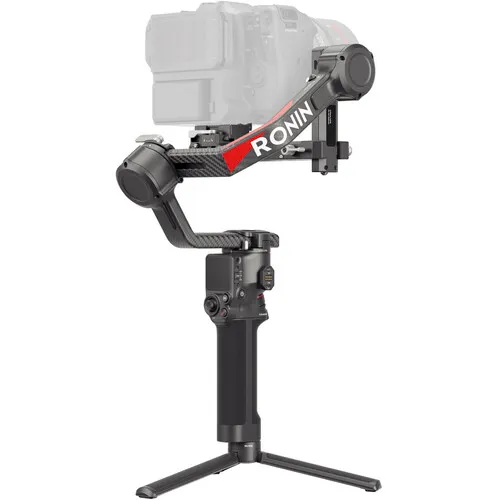
Static video has its place, but the moment a shot starts to move — a slow push toward a subject, an arc around a product — it reads as intentional. The hard part has always been making that movement *smooth*. Handheld footage shakes; sliders only go in a straight line. The DJI Ronin RS 2 is the tool most Denver shooters reach for when they want effortless, motivated movement that doesn't look like a home video. It's a 3-axis stabilizer that carries a genuine working rig and still packs down small enough to carry into a studio in one hand.
What the RS 2 is
The Ronin RS 2 is DJI's professional 3-axis camera gimbal — a motorized cradle that holds your camera level and steady on the pan, tilt, and roll axes while you walk, crouch, or arc around a subject. It's the more capable sibling in the RS line, built to carry mirrorless and small cinema cameras with a fast lens and accessories attached. The figures that matter on set:
DJI Ronin RS 2 — key specs
- Axes
- 3-axis (pan, tilt, roll)
- Tested payload
- 4.5 kg (10 lb) dynamic, handheld
- Gimbal weight
- ~960 g (body, excluding plates)
- Construction
- Carbon fiber, aluminum alloy, stainless steel
- Runtime
- Up to ~12 hours per charge (balanced)
- Control
- 1.4-inch touchscreen · DJI Ronin app · focus-motor + RavenEye ports
Two details make the RS 2 punch above its size. The arms are carbon fiber, which is why a gimbal this light can still hold roughly 4.5 kg of camera, lens, and accessories without sagging or straining the motors. And it has dedicated ports for a focus motor and DJI's RavenEye image-transmission system — so it isn't just a stabilizer, it's the hub of a small motion rig.
Why creators reach for it
Movement that looks deliberate, not shaky
A gimbal's whole job is to absorb the chaos of a human body in motion and hand the camera a smooth ride. On the RS 2, DJI's stabilization keeps the horizon locked and the framing steady while you move, so a slow walk toward a founder in an interview, or a glide across a styled product table, comes out buttery instead of jittery. That single capability is the difference between footage that feels produced and footage that feels accidental.
It carries a real rig, not just a bare body
Plenty of small gimbals balance a stripped-down camera and quit the moment you add a cine lens or a cage. With a tested dynamic payload of about 4.5 kg, the RS 2 holds a full-frame mirrorless body — a Canon EOS R5 or comparable — with a fast prime and a matte box still attached. You don't have to strip your build down to fit the tool, which keeps your look consistent between locked-off and moving shots.
Focus you can pull while it moves
Movement and focus fight each other: as the camera travels, the distance to your subject changes, and a soft frame ruins an otherwise great move. Our Pro Combo includes the RS 3D Focus System, so you can rack focus remotely while the gimbal travels — keeping an eye sharp through a push-in, or shifting attention from a product to the hands holding it. Pairing motion with controllable focus is what separates a quick clip from a finished shot.
Working with it on a studio shoot
The honest truth about gimbals is that the magic is in the balance. Before the motors ever switch on, you mechanically balance the camera on all three axes so the rig sits neutral — that's a few minutes of careful setup that pays off in smoother footage and longer battery life. Build your camera the way you'll shoot it (lens, filters, any cage) *before* you balance, because changing the payload means rebalancing.
In a controlled room, a gimbal and a small crew go a long way. One operator runs the RS 2 while a second pulls focus or watches the tether and monitor; a slow orbit around a product on the cyc wall, or a drifting move past an interview subject, adds the production polish clients notice. Because the studio floor is clean and level, your moves stay even — no curbs, no crowds, no wind.
When to rent it
A gimbal is the kind of tool you use intensely on shoot days and leave in the case the rest of the time — which makes it a natural rental rather than a purchase. Renting wins when:
- The job calls for movement — bill the gimbal (and focus motor) to the production and hand it back at wrap.
- You shoot motion occasionally — a few interview or product-video days a year doesn't justify owning and maintaining one.
- You want the focus system too — renting the Pro Combo gets you the gimbal and the RS 3D Focus System matched and ready, no separate sourcing.
- You're already booking the room — add it to a studio day and walk in with everything balanced and charged.
We rent the Ronin RS 2 as the Pro Combo, with the RS 3D Focus System, the R Vertical Camera Mount, and the Twist Grip Dual Handle available à la carte so you can match the build to the shot. Everything lives on the same accessory shelf as the monitors, cages, and grip that round out a motion rig.