
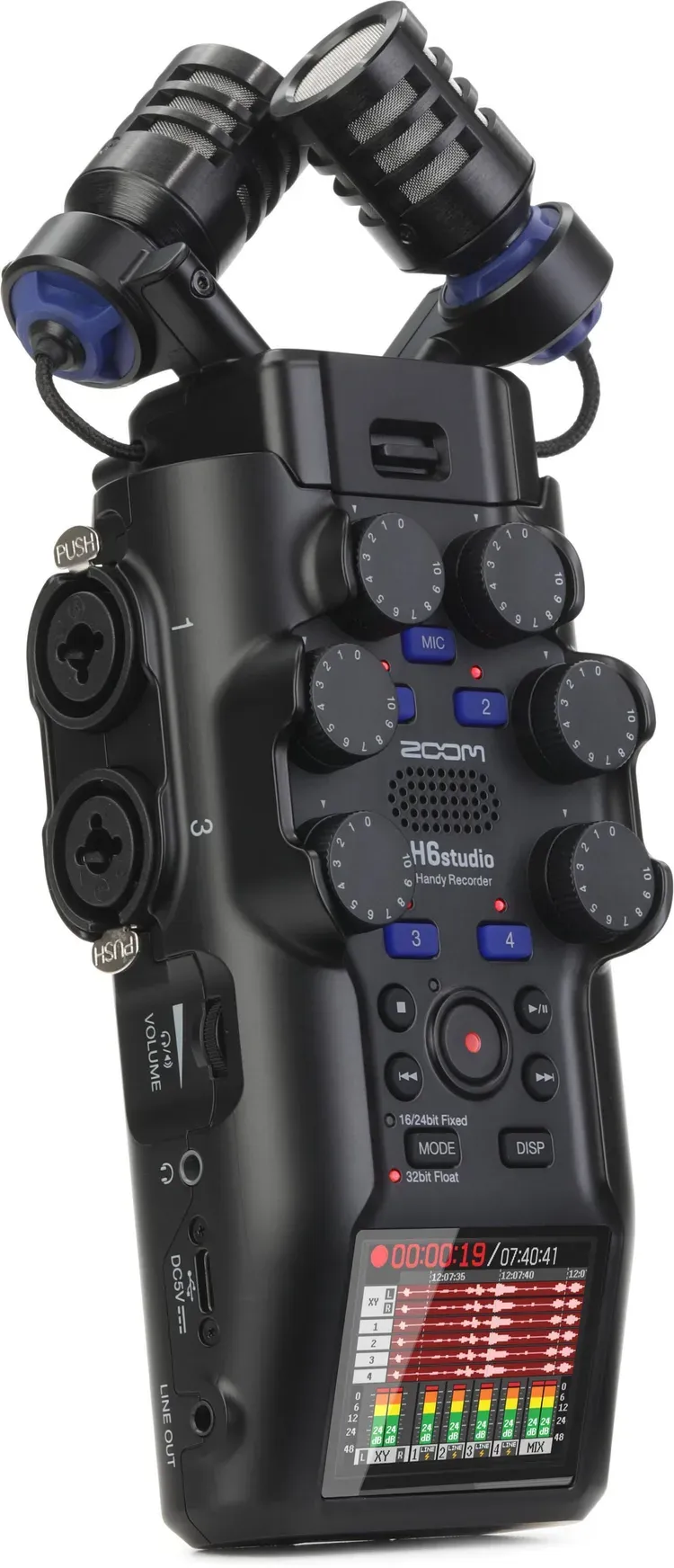
Audiences forgive a lot in the picture and almost nothing in the sound. A clipped, distorted answer in an interview or a buried line under room noise is the kind of mistake you can't fully fix in post — and on a paid shoot, you don't get to ask for the take back. The Zoom F6 is the recorder that takes that risk off the table. It's small enough to clip to a belt, but it records six inputs in 32-bit float, which in plain terms means your dialogue is far harder to ruin. It's the field recorder we hand to anyone who can't afford to lose a word.
What the F6 is
The F6 is a compact multitrack field recorder: a dedicated box that captures professional audio onto an SD card, separate from your camera. You plug microphones into its XLR inputs — lavaliers, a boom, an interview mic — and it records each as its own clean track. The numbers that matter:
Zoom F6 — key specs
- Inputs
- 6 discrete inputs, locking XLR connectors
- Tracks
- Multitrack recording (up to 14 tracks)
- Bit depth
- 32-bit float (plus 16/24-bit)
- Converters
- Dual A/
D converters per channel for wide dynamic range - Sample rates
- Up to 192 kHz
- Phantom power
- +24V / +48V, selectable per input
- Timecode
- Built-in timecode (3.5 mm in/
out) - Media
- SD / SDHC / SDXC
Recording separately from the camera is the first reason pros use a box like this. Camera audio is fine for reference, but a dedicated recorder gives you isolated tracks, real phantom power for good microphones, and a clean, reliable file you control. The second reason — the one that's genuinely changed how shoots run — is 32-bit float.
What 32-bit float actually means
Here's the plain-English version. In ordinary 24-bit recording, you have to set the input level (the gain) correctly *before* you hit record. Set it too high and a sudden loud moment — a laugh, a raised voice — clips: it slams into the ceiling and distorts permanently, and no amount of post work brings it back. Set it too low to be safe, and quiet speech sits down in the noise floor, hissy and thin when you raise it later.
32-bit float removes that tightrope. The dynamic range is so vast that the recording captures both the loudest peaks and the quietest whispers at full quality, and you simply adjust the level afterward in your editor. Combined with the F6's dual A/D converters — two analog-to-digital paths per channel working together — the practical result is the headline Zoom makes about this recorder: you essentially don't have to set gain. A take that would have clipped on an old recorder is recoverable; a take that would have been too quiet just gets turned up cleanly.
Why creators reach for it
Multiple mics, cleanly separated
A typical interview is two people, each on their own lavalier, often with a boom overhead as a backup or for a fuller sound. The F6's six inputs let you record every source on its own isolated track, so in the edit you can balance each voice, mute a cough on one mic without touching the other, and choose the best-sounding take. For a panel, a podcast-style sit-down, or a host plus guest, that separation is what makes the mix manageable.
Timecode that keeps sound and picture in step
On a multi-camera or long-form shoot, the recorder and the cameras each run their own clock. Built-in timecode lets you stamp every device to a shared reference so the editor can line audio to picture automatically instead of clapping and nudging clips by hand. On a one-camera interview it's a convenience; on anything bigger it's a real time-saver in post.
Small enough to live on a belt or a cart
The F6 is genuinely pocketable, which means it works two ways: bag it on a belt for a roaming, run-and-gun setup, or sit it on the studio cart for a controlled interview where the subject isn't moving. Either way you get full-size, professional XLR sound out of a box that doesn't dominate the kit.
Building the rest of the sound kit
A recorder is only as good as what feeds it. The F6 pairs naturally with the rest of the audio shelf for a complete capture chain:
- Wireless Lavalier Kit — clip-on mics for clean, consistent dialogue when a subject is seated or moving.
- Boom Pole with XLR — an overhead shotgun for a natural, room-aware sound, or as a backup to the lavs.
- Zoom F3 — a two-input, 32-bit float recorder when a single subject is all you need to capture.
- Zoom H6 — a handy recorder with interchangeable mic capsules and four combo inputs for grab-and-go or scratch audio.
When to rent it
Good location sound is occasional for most photo-and-video shooters, which makes the F6 a smart rental rather than a shelf purchase. Renting wins when:
- The job has dialogue — interviews, testimonials, or talking-head content where the words are the deliverable.
- You need real isolation — multiple subjects each on their own track, not a single camera mic.
- You shoot sound rarely — a recorder and a couple of mics a few times a year doesn't justify owning a sound kit.
- You're already booking the room — add the F6 and mics to a studio interview day and walk in ready to roll sound.
We rent the Zoom F6 on its own or alongside the Wireless Lavalier Kit and Boom Pole for a complete dialogue chain, with the smaller Zoom F3 and H6 available when the job is lighter. It all lives on the same accessory shelf as the cameras and grip that round out a video build.