
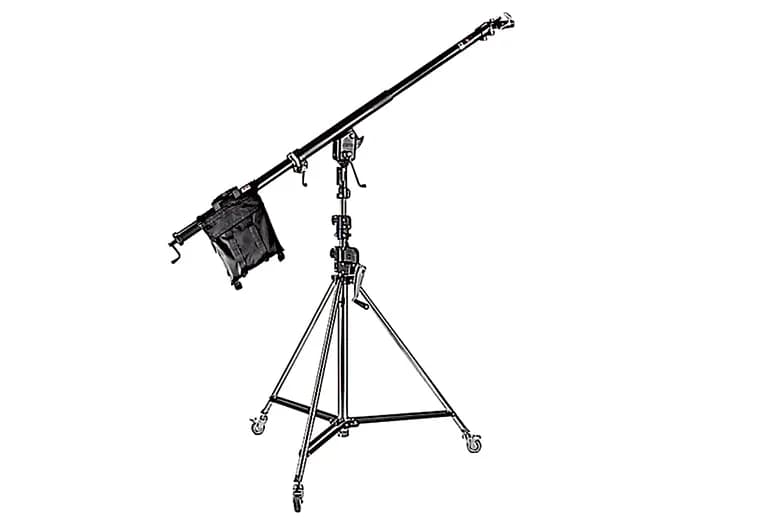
Look up at the sky at noon and you're seeing the oldest light in photography: a source directly overhead. Used deliberately, top light is gorgeous — it carves cheekbones, puts a clean catchlight up high in the eye, and pours a soft wash down onto a product from the one angle a tripod-style stand physically cannot reach. The problem is geometry. To hang a softbox straight above your subject, you'd have to plant a stand leg where the subject is standing. The solution is a boom: an arm that cantilevers the light out over the action from a base safely off to the side. Done right it's effortless. Done wrong it's a heavy modifier swinging down onto someone's head, so counterweighting is the part you never improvise.
What a boom is and how it works
A boom is a long arm that pivots on a stand, with your light hanging off the far end and a counterweight loaded on the near end. It's a seesaw. The pivot point (the fulcrum) sits on top of a sturdy stand; everything past the pivot on the light side is trying to tip the whole rig forward, and the weight on the back side is what balances it out. Get the two sides in balance and the arm floats — you can swing it, raise it, and aim the light with one hand. Get them out of balance and the heavy side slams down.
Booms come in sizes for the job. A Mini Boom handles a small light or a flag at modest reach. A Super Boom is the go-to studio workhorse, long enough to fly a real softbox well out over a set and stiff enough not to sag. A MegaBoom is the big one — maximum reach and load for when you need a large source high above a wide scene or a group, and it rides on a heavy stand because of everything it's carrying. The longer the boom and the heavier the light, the more counterweight and the more anchoring you need.
Why a boom beats a stand for top light
A standard light stand can only put a light where its own legs can stand — it holds weight straight up over its base. The instant you want light above your subject, or out over a table you're shooting down onto, or tucked in close from a high angle, the stand's legs are in the wrong place. A boom moves the support base out of the shot and reaches the light in over the top from the side. That single capability unlocks a whole category of looks:
- Overhead key or beauty light — a softbox boomed straight above and slightly in front gives that high, wrapping fashion-and-beauty look, with the stand entirely out of frame.
- Hair and separation light — a small source boomed in from behind and above kisses the top of the head and lifts the subject off the background.
- Top-down product and flat-lay — fly a soft source directly over the table so it lights a tabletop set evenly with no stand leg in the shot.
- Reach over obstacles — get light past furniture, set pieces, or talent that a legged stand simply can't straddle.
Rigging a boom correctly (and safely)
Counterweight the back, then balance to neutral
Hang your light on the front first, then load weight on the tail until the arm balances and floats — neither end crashing down when you let go. Pumpkin counterweights (round steel donuts, often 15 lb each) thread onto the back of the arm for exactly this; add donuts until the seesaw evens out. Aim for the arm to sit just barely tail-heavy so a small bump nudges the light *up and away*, not down toward your subject. Never boom a light without counterweighting it first — an unbalanced boom is a falling boom.
Anchor the stand, not just the arm
Balancing the arm keeps the *boom* from tipping, but the whole rig can still topple if the *stand* isn't anchored. Put a sandbag (or two) over the stand's legs — especially the leg under the load side — to keep the base planted. For a heavy MegaBoom, that anchoring isn't optional. A boom that's perfectly balanced on a stand that walks across the floor is still an accident; weight the base and balance the arm.
Mind the swing radius and the reach
A boom turns your light into something that sweeps through a big arc of space. Before you let go, look at where the arm and light can swing if someone bumps it — keep that arc clear of heads, faces, and other gear. Respect the reach, too: every foot you extend the arm multiplies the leverage and demands more counterweight and a more solid stand. Don't max out a small boom with a big modifier; size the boom to the load. And when you raise, lower, or re-aim, keep a hand on the arm and move it slowly — a boomed light has momentum.
The boom in the studio workflow
In a controlled studio you build light to a plan and lock it down, and the boom is usually the centerpiece of that plan: the main soft source floating in over your subject while C-stands handle the flags, fills, and accents around it. Roll a High Junior three-riser roller stand into position for the heavy lifting, mount the Super Boom or MegaBoom, hang your softbox, donut the tail until it floats, bag the base, and you've got a top light you can subtly raise, lower, and feather all day without touching the stand's footprint. Because nothing in a studio moves unless you move it, a balanced boom stays exactly where you set it from the first frame to the last — which is the whole reason top light is so reproducible indoors and so maddening to chase outdoors.
When to rent it
Booms, heavy stands, and a pile of counterweights are bulky, specialized, and used in bursts — classic rent-don't-own gear. Renting makes sense when:
- You need real overhead reach — a Super Boom or MegaBoom and a heavy stand are a lot to buy and store for a few shoots a year.
- You need the counterweights to match — a boom without enough pumpkins to balance your light is just a hazard; rent the weights with the arm.
- You want it mobile — a roller base lets you move the balanced rig, which a personal kit rarely includes.
- You're already renting the room — add the boom package to the studio booking and walk in ready to fly your key.
Our grip and electrical rental inventory includes the MegaBoom at $75, the Super Boom with weight at $20, and a Mini Boom at $10, plus a roller for the Super Boom at $10, the High Junior three-riser roller stand at $20, and 15 lb pumpkin counterweights at $4 each. Grab enough pumpkins to balance whatever light you're flying — and pull the sandbags for the base from production supply.