
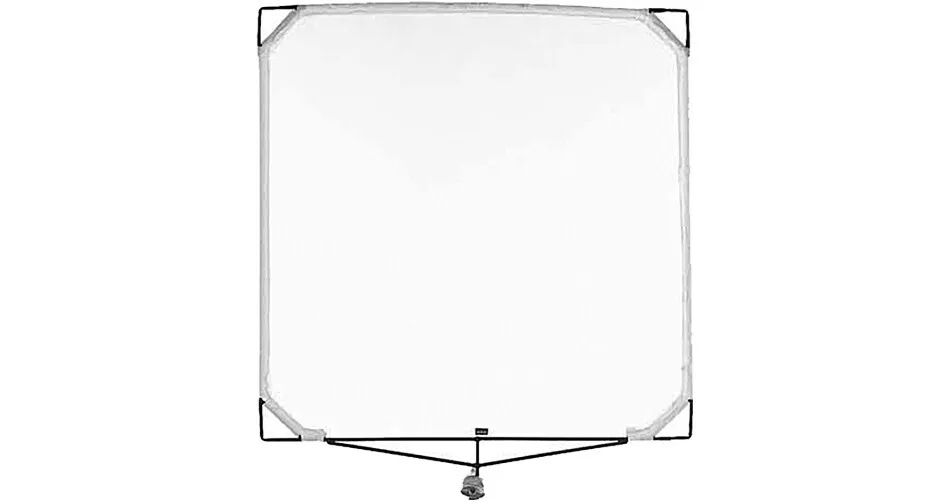
When you see impossibly soft, wrapping light on a fashion campaign or a film set — light that seems to come from everywhere and nowhere — it usually isn't a softbox. It's a fabric stretched across a big metal frame, with a hard light blasting through or bouncing off it. This is the grip department's approach to soft light, and it scales far bigger than any box: a 12×12' frame turns a single punchy strobe into a soft source the size of a wall. The frame is just the skeleton; the fabric you stretch onto it decides everything about the light. Learn the fabrics and you can build any quality of soft light you want, at any size.
What it is and what it does to light
A diffusion frame works on the same principle as every soft modifier: make the source bigger relative to the subject and the light gets softer. The difference is scale and modularity. You aim a hard light — a strobe, an HMI, or the sun — at the frame from a distance, and the whole fabric panel lights up and becomes your new, much larger source. Position it overhead and you get a soft toplight like an overcast sky; position it to the side and you get a giant soft key; stand it between a window and your set and you tame harsh sun. Because the frame and fabric are separate, one frame plus a handful of cloths covers a huge range of looks.
The fabrics, and what each one does
This is where the craft lives. The terms come straight from the grip world, and they describe what the cloth does to the light passing through (or off) it:
- Silk / China silk — a true diffuser. Light passes through and comes out soft and even, with a gentle, beautiful falloff. A full silk is the go-to for that soft, daylight-cloud quality; china silk is a lighter, more delicate weave for a touch of softening when you don't want to lose much output.
- Scrim (single net / double net) — nets don't really diffuse; they *cut* intensity without changing the light's hardness much. A single net knocks the light down about one stop, a double net about two — perfect for darkening one area of a frame, feathering exposure across a subject, or balancing a too-bright background. Think of them as dimmers made of fabric.
- Griff (Grid cloth / heavier diffusion) — a tougher, denser diffusion that softens more aggressively and holds up to wind and big sources; a workhorse when you want serious, even softening over a large area.
- Solid — opaque black. It passes no light at all, so it's used to *block*: cast a shadow, create negative fill across a big area, or flag spill off your set. The opposite of a silk — subtract instead of soften.
- UltraBounce — a large white/black bounce cloth. The white side throws a giant soft fill (a wall-sized reflector); the black side gives wall-sized negative fill or blocks light.
The mental model: silk softens, net cuts, solid blocks, bounce reflects. Once those four verbs are clear, you can walk up to any frame and pick the cloth that does what the shot needs.
Single vs double vs silk — the common confusion
It's worth nailing the difference, because it trips people up. A silk changes the *quality* of the light: hard light goes soft. A net (single or double) changes the *quantity*: it dims the light a stop or two but leaves its hardness mostly intact. So if a face is too contrasty, you want a silk (soften it). If a face is correctly soft but simply too bright — or one side of the frame is hotter than the other — you want a net (cut it). Reaching for the wrong one is the classic beginner mistake: nets won't fix harsh light, and silks will over-soften light that was already fine.
The look it creates
A big silk overhead gives the unmistakable 'window-light everywhere' look: soft, directional, with a long gentle gradient and no harsh edges — flattering on skin and gorgeous on product. Push light through a 12×12' from the side and you get a soft key so large it wraps a full-length figure with even light head to toe. Add nets to shade a background or feather the edges, a solid to drop a deliberate shadow, and an UltraBounce to fill the opposite side, and you've built a complete, cinematic lighting environment out of frames and fabric.
Best subjects and use cases
- Fashion and full-length — a 12×12' silk is large enough to light a standing or moving subject evenly, top to bottom.
- Group portraits — one big soft source covers many faces with consistent light.
- Video and motion — soft, flicker-free toplight and sidelight that holds across a moving frame.
- Product and food — an overhead silk gives that even, soft tabletop light catalogs are built on.
- Taming hard sources — diffuse a hard strobe, an HMI, or a sun patch coming through the windows.
On the cyc and in the studio
Big frames need height, floor space, and a clean room to rig safely — which is exactly what the studio provides. There's room to fly a 12×12' overhead on stands, back a subject off the cyc, and light the whole thing with a single strobe blasting through the silk. The controlled room also lets you commit to the look: with the blackout shades down you can build a pure built-light environment, or with them up you can push a silk into the window daylight and combine the two. A frame this big is impractical on a cramped location and natural in a real stage.
The Scrim Jim and gel frame
Not every job needs a 12×12'. The Scrim Jim is a lighter, quicker modular frame — we stock 8×8' and 6×6' — that snaps together fast and takes the same family of cloths (diffusion, silver/white bounce, solid). It's the nimble option for tighter setups, smaller crews, or a quick soft source you can rig in minutes. We also keep a gel frame for placing large sheets of color-correction or effect gel in front of a source — handy for warming a big light to match window daylight, or coloring a background wash across the cyc.
Setup and control
- Distance from the light sets softness — the farther the source from the fabric, the more evenly the whole panel lights and the softer the result; too close and you get a hot spot.
- Distance to subject sets falloff — bring the lit frame close for soft, fast falloff; back it off for harder, more even coverage.
- Rig it safely — big frames catch air like sails; use heavy stands, sandbags, and a grip, especially overhead. The studio's space makes this manageable.
- Stack and combine — a silk to soften plus a net to feather plus a solid to flag is a normal, powerful combination.
- Match the fabric to the verb — soften (silk), cut (net), block (solid), reflect (UltraBounce); pick by what the shot is missing.
When to rent it
Frames and fabrics are bulky, fragile, and occasional — the textbook case for renting rather than owning:
- You need huge, cinematic soft light that no softbox can match in size.
- You're lighting full-length, groups, or motion and want even coverage top to bottom.
- The look is project-specific — you don't run a 12×12' every week, so rent it for the days you do.
- You're already booking the studio — add the frame and a set of cloths to the reservation and rig it on the cyc.
We rent the 12×12' and 6×6' butterfly frames with the full fabric set — scrim, silk, china silk, griff, solid, and UltraBounce — plus the Scrim Jim in 8×8' and 6×6' and a gel frame, all on the modifier wall and ready to shape the strobe of your choice.