
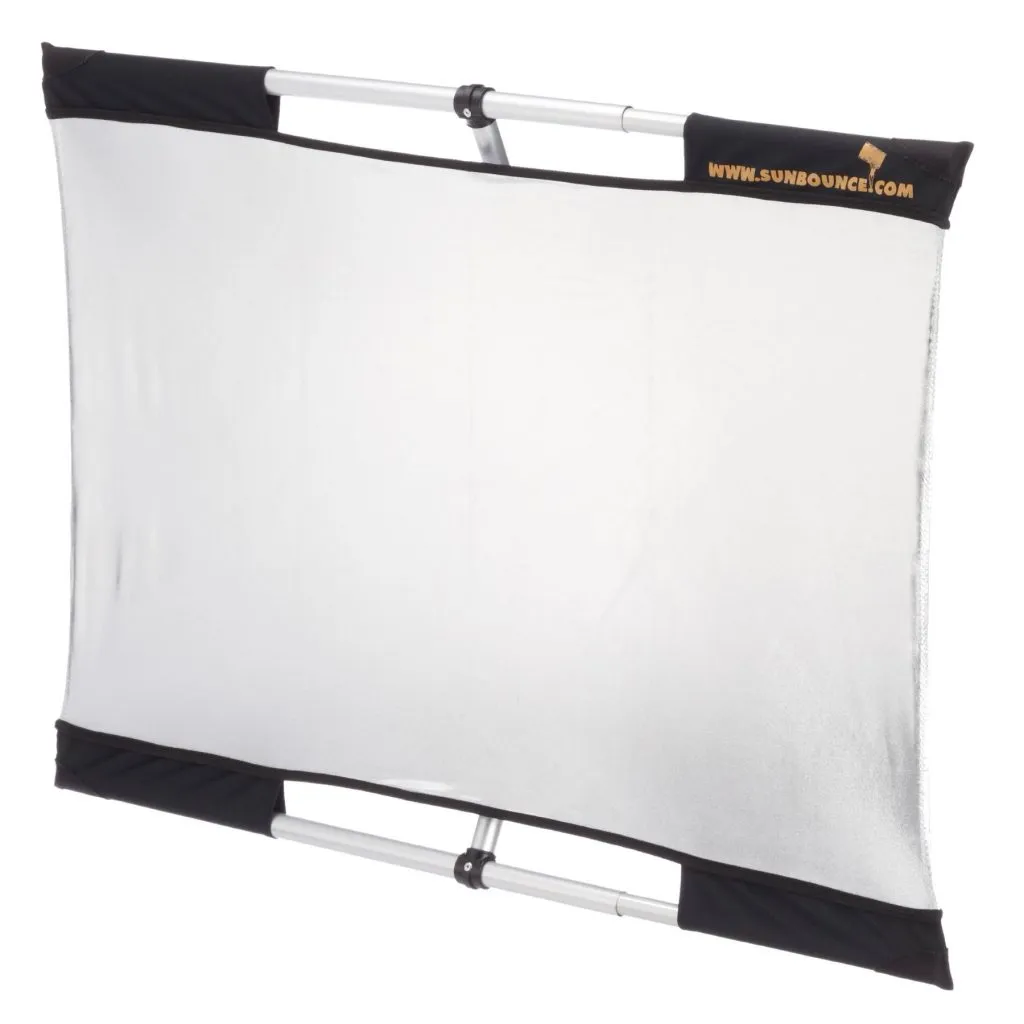
The sun is the biggest, cheapest light you'll ever shoot with, and most of the time it's pointed the wrong way and far too hard. A SunBounce is the tool that fixes that. It's a lightweight aluminum frame with a fabric screen stretched across it, and it does one of two jobs depending on which cloth you load: a reflective cloth bounces sunlight back onto your subject as a big, soft fill, and a translucent silk screen lets you diffuse the sun by softening it on its way through. Either way, you take light you found and turn it into light you shaped — no battery, no strobe, no power required.
What it is and what it does to light
Think of a SunBounce as two modifiers sharing one frame. As a reflector, you angle the silver or zebra cloth to catch the sun and throw it back into the shadow side of a face — filling in dark eye sockets and harsh contrast with a soft, broad bounce. Because the cloth is large, that bounced light is soft and wrapping, very different from the hard direct sun it came from. As a diffuser (called a silk), you place the translucent screen between the sun and your subject so the light passes through the fabric; the small flash-tube-like point of the sun becomes a big, soft panel, and hard shadows melt into gentle ones. Same gear, two opposite effects: add light back, or take the hardness out.
The cloths, and what each one does
The cloth you load sets the result. The SunBounce materials we stock map directly to the looks confirmed by the manufacturer:
- Zebra (gold/silver) — a mix of gold and silver threads that bounces a gently warm light, described by SunBounce as creating 'a healthy skin complexion even if cloud cover is thick.' It's the everyday workhorse: efficient, flattering, with a touch of warmth.
- Silver / White — silver bounces a neutral, efficient fill that, per SunBounce, 'does not change the colour temperature' and keeps the light's character intact; the white side gives a softer, lower-contrast bounce when you want something gentler.
- Silk diffusion (1/3 and 2/3 stop) — translucent white screens with no optical brightener. The 1/3-Stop Silk takes the edge off the contrast for a 'medium-soft' light; the 2/3-Stop Silk softens further for 'wonderfully soft light.' These go between sun and subject to diffuse, not bounce.
Our Kit pairs a 4×6' frame with the full silk set — 1/3, 2/3, and full — so you can dial the exact amount of softening a scene needs, the same way you'd choose a diffusion strength on a softbox.
The look it creates
Bounced, you get clean, controllable fill that opens shadows without flattening the scene — the difference between a squinting subject with black eye sockets and a glowing one with light, open eyes. Diffused, you get the look people pay for: soft, even, directional daylight with a gentle shadow transition, as if the harsh sun had been replaced by a giant overcast sky exactly where you needed it. Zebra adds a healthy warmth; silver keeps things neutral and punchy; silk simply makes everything kinder.
Best subjects and use cases
- Outdoor portraits — silk to soften direct sun overhead, or a zebra bounce to fill the shadow side.
- Lifestyle and brand — natural-looking light that still reads intentional and controlled.
- Product and food on location — a silk overhead turns harsh midday into soft, even tabletop light.
- Anywhere you want daylight character without hauling strobes and power.
The SunSwatter for direct sun
When the sun is high and hard, the SunSwatter Pro is the move: it's a large diffusion screen on a frame, designed to be held up between the sun and your subject so the light pours through it softened. Boom it overhead or have an assistant hold it just out of frame, and you've effectively given the scene its own portable cloud. It's the fastest way to tame a brutal noon sun into something flattering, and it pairs naturally with a bounce on the shadow side to balance the fill.
Working with the studio's window daylight
SunBounce isn't only an outdoor tool — it's just as useful with the big windows at the studio. Those windows already give you a soft, directional daylight source; a SunBounce lets you finish it. Set a silver or zebra cloth opposite the windows to bounce that daylight back as fill and balance the contrast across a face. Or, when the sun comes through hard at the right time of day, stand a silk in the window light to soften it further. You get the honesty of natural window light with the control of a shaped key and fill — and on a darker day, you can switch to strobes and treat the SunBounce as bounce for those instead.
Setup and control
- Angle is everything for bounce — tilt the reflector until you see the light land where the shadow was; small changes move it a lot.
- Distance sets softness — closer is softer and brighter for both bounce and silk; back it off for a harder, more even spread.
- Mind the wind — a 4×6' frame is a sail outdoors; sandbag the stand or have a grip hold it.
- Pick the strength — start with a 1/3 silk and step up to 2/3 (or full) only if the light is still too hard; over-diffusing kills the direction that makes daylight look good.
- Size to the subject — the 3×4' is nimble for head-and-shoulders; the 4×6' covers a standing figure or a tabletop.
When to rent it
- You're shooting in daylight — outdoors or in the window-lit studio — and want it soft and controlled.
- You want natural-light character without renting strobes, packs, and power.
- The need is occasional — a frame and a set of cloths is easy to rent for the shoots that call for it.
- You're booking the studio — add a SunBounce to work the window daylight, and keep strobes on standby for a gray day.
We rent SunBounce frames in 4×6' and 3×4', the SunSwatter Pro 4×6' for diffusing direct sun, and a Kit that bundles a 4×6' frame with the full silk set — plus zebra, silver/white, and silk cloths to match the light you're after. Browse the modifier wall for the full set.