
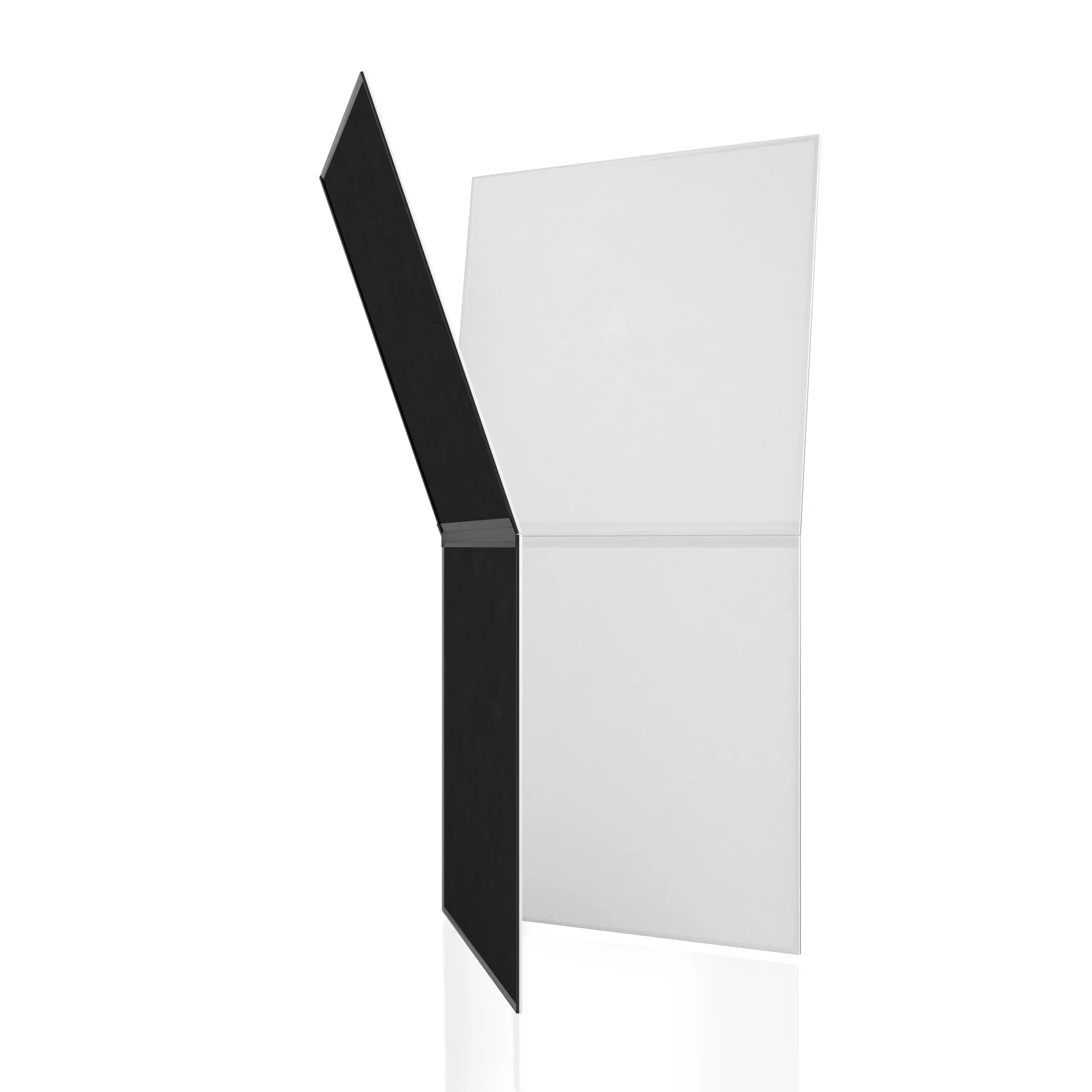
The most useful piece of lighting gear in a lot of studios isn't a light at all. It's a V-flat: two big boards hinged into a 'V' that stands on its own, white on one side and black on the other. It produces no light and uses no power — it only moves light that's already in the room. And yet a single V-flat will improve more portraits than almost any strobe you can add, because it controls the one thing that separates a flat snapshot from a sculpted photograph: contrast. Flip it white to add light into the shadows, or flip it black to take light away, and you've shaped the whole feel of the frame for the price of a board.
What it is and what it does to light
Every lit subject has a bright side (facing the key) and a shadow side (away from it). How dark that shadow side falls is what makes light look soft and open or punchy and dramatic. A V-flat lets you set that, with no electricity involved:
- White side = positive fill. Place the white panel on the shadow side and it catches spill from your key and bounces it back into the shadows. The dark side lifts, contrast drops, and the light feels softer and more even — flattering for beauty, headshots, and clean commercial looks.
- Black side = negative fill. Place the black panel on the shadow side and it does the opposite: it *absorbs* the ambient and bounced light that would otherwise sneak into the shadows. The shadow side goes deeper, contrast rises, and the subject gains shape, edge, and drama.
That second move — negative fill — is the one people underuse. We instinctively reach to add light, but often the photo wants *less* light on the shadow side, not more. Subtracting light is how you carve a jawline, define a cheekbone, and give a face dimension. A black flat is the simplest, cheapest way to do it, and it's reversible: don't like the contrast, swing it to white.
The look it creates
White, you get open, gentle, low-contrast light: even skin, soft shadow transitions, the clean look that catalog and corporate work lives on. Black, you get sculpted, moody, high-contrast light: deep shadows, a strong sense of form, the chiseled quality of editorial portraiture and fitness photography. The remarkable part is that the *key light never changes* — same strobe, same modifier, same exposure. You're only deciding how the shadow side renders, and that single decision swings the entire mood.
Best subjects and use cases
- Portraits and headshots — white to flatter and open, black to sculpt and define.
- Beauty — a white flat (or two) under the chin lifts shadows for that clean, shadowless wrap.
- Fitness and physique — black flats on both sides carve muscle definition that fill would erase.
- Product and still life — black flats add deep, glossy shadow edges to bottles, watches, and packaging.
On the cyc and in the studio
V-flats really come alive on the cyc wall. A big white cyclorama bounces a lot of light around the room — wonderful for an airy high-key look, but a problem when you want contrast, because the whole space is acting like a giant fill card. That's exactly when black flats earn their keep: stand them just out of frame on the shadow side to soak up the cyc's bounce and let your shadows actually go dark against the white background. You get a clean white field behind the subject and real contrast on the subject — a combination the cyc can't give you on its own.
The Eyelighter and reflectors
A V-flat is the big, blunt instrument; sometimes you want a more precise lift. The Eyelighter is a long, curved silver reflector that sits low and in front of the subject, wrapping a bright, even strip of light up into the eyes and under the chin — it adds a gorgeous catchlight and fills under-eye shadow without flattening the whole face. Smaller reflectors and FlexFills (collapsible white/silver/gold discs) do the same job in a handheld, packable form, perfect for a tight tabletop fill or a quick bounce on location. Together with the V-flats, they cover the full range from broad, room-scale contrast control down to a precise glint in the eye.
Setup and control
- Distance sets strength — the closer the flat, the stronger the effect; slide it in until the shadow looks right, then stop.
- Angle it to the subject — for negative fill, the black surface should 'see' the shadow side of the face as fully as possible.
- Use two — flats on both sides give you symmetric control; one white, one black lets you fine-tune each side independently.
- Free-standing by design — the hinged V stands on its own, so you usually don't even need a stand, just floor space.
- It's reversible in seconds — the whole point is that white and black are one flip apart, so audition both before you commit.
When to rent it
V-flats are cheap to rent and awkward to own — big, flat, and bulky to store and transport — which makes them a perfect rental add-on:
- You want contrast control without buying strobes — a flat does more for shape than another light often does.
- You're shooting on the cyc and need black flats to claw back contrast the white room is stealing.
- Storage and transport are the problem — they're a hassle to keep, easy to rent for the day.
- You're already booking the studio — add a flat or two (and an Eyelighter) to the reservation and shape the light on the cyc.
We rent the 40×80" black-and-white V-flat, the Eyelighter for that wrap-up catchlight, and a range of reflectors and FlexFills for handheld fill — all on the modifier wall alongside the strobes you'll shape with them.